.jpg)


.jpg)

 English daily published in Bengaluru & Doha

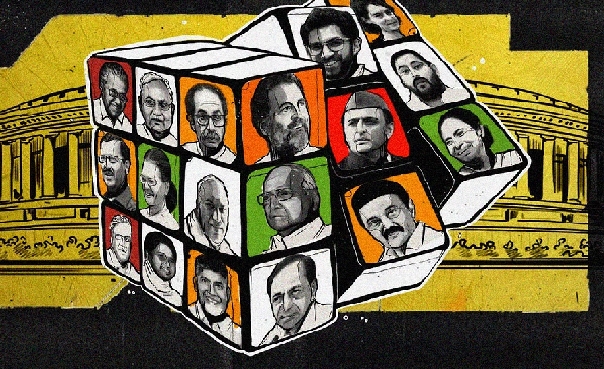
Worthless Pursuit of Opposition Unity Mirage
Shekhar Gupta
Whenever a majority government is so firmly entrenched in power that it seems improbable for one challenger to defeat it, the idea of “Opposition unity” returns. We need to explain why this is a bogus, defeatist, and repeatedly failed idea. Why this often eds up helping a well-settled incumbent. And why this is the political equivalent of selling snake oil. The opposition is rehashing the same failed idea today, with just a year to go before the first votes are cast for the general election in 2024.
We can understand where they are coming from. Read their lips: We have the right to seek power. None of us has the weight to defeat Narendra Modi. We have to do something. We can’t just sit at home waiting for another five years on depleting opposition benches. Mujhe kuchh karna hai (I must do something, after all) is a laudable sentiment. But must it be what’s been done multiple times before, with the same dismal results? The essential flaw in this tired and lazy idea is the belief that you can defeat a powerful leader and their party with arithmetic.
That is, if one party or leader could not defeat the incumbent, why not get them all together? After all, nobody, whatever the majority, gets more than 50% of all the votes in India. While the copyright on the argument that in elections, chemistry matters more than arithmetic, remains with the late Arun Jaitley, we can expand it to argue that electoral politics isn’t about arithmetic plus chemistry either.
There is also psychology, the rise of the transactional, what’s-in-it-for-me voter, some philosophy and, to be sure, pathology. You will need a convincing mix of all these to persuade a comfortable voter to change sides. Then you imagine Rahul Gandhi (or Mallikarjun Kharge), Mamata Banerjee, Sharad Pawar, Uddhav Thackeray, Arvind Kejriwal, M.K. Stalin, K. Chandrashekar Rao, Pinarayi Vijayan, Akhilesh Yadav, Mayawati, Nitish Kumar, Hemant Soren, Tejashwi Yadav, Naveen Patnaik and Y.S. Jagan Mohan Reddy on the same stage.
All of them, added up, will make formidable arithmetic. Then you run into three big problems. First, there is no way you can see them all together in one alliance against the BJP in the foreseeable future. Second, some of them can unite nationally (most regional parties, for example), but many have rivalries with the Congress in their home states. Third and most important, there is no common philosophical or ideological thread to bind them. Once you take out Patnaik and Jagan, who today see no particular need to fight the BJP for the Lok Sabha, your arithmetic depletes anyway.
Next, you can list those who cannot go with each other. Akhilesh and Mayawati, for example. Then you have odd combinations where opposition parties are also rivals in important states. The Congress with AAP everywhere and with KCR in Telangana. Then, the contradictions like the Congress and the Left. Ideologically, the two are closer than they have ever been since 1969, when Indira Gandhi’s minority government survived on votes from the CPI, kept in line by her well-wishers in the Kremlin.
They fought the Tripura Assembly election in an alliance just this February, and in West Bengal earlier. Rahul Gandhi’s language on political economy is the closest his party’s has been to the Left’s since 1991. At the same time, they are locked in perpetual combat in Kerala. Even in the unlikely event that they might divide seats to contest in Kerala, it won’t convince many Left voters to vote for the Congress just to keep Modi out.
The third is the lack of a common ideology and message. In its absence, the voter is shrewd enough to see through an alliance of convenience, of people with diverse and often conflicting interests coming together to evict just the guy they overwhelmingly voted for twice. The rest, as Indira Gandhi first demonstrated in 1971, is easy: They say remove Indira, but Indira ji says remove poverty. (Woh kehte hain Indira hatao, Indira ji kehti hain garibi hatao.) You make a choice. We know what that choice was. It won’t be any different this time.
Our political history tells us this has never worked. A united Opposition does work in some specific, limited situations, especially in the states. It worked, for example in the heartland states in 1989. But never as some brilliant pan-national collection of diverse interests with no ideological or political core. The first real effort for opposition unity was made in 1967.
India was going through grave economic and social hardship, coming out of two wars (1962, China and 1965, Pakistan), two consecutive, crippling droughts, and the deaths of two successive prime ministers (Nehru and Shastri) while in office. Indira Gandhi, inexperienced as prime minister and still in her forties, looked beatable in India’s first post-Nehru electio
.jpg)
.jpg)
.jpg)
.jpg)
.jpg)
.jpg)