.jpg)


.jpg)

 English daily published in Bengaluru & Doha

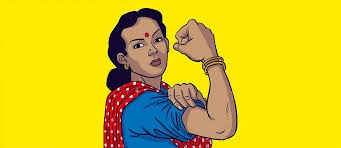
Why Seat Reservation for Women?
Nazeer Waris
Bengaluru: Last week India's Parliament passed a bill that reserves one-third seats of Lok Sabha for women. Lok Sabha has 543 seats.
If 33 per cent seats are reserved for women only, then the House will have roughly 179 women MPs. Currently, Lok Sabha has 78 women MPs. This means when the new Act comes into effect, the House will see 100 more women MPs.
Women's participation has been rising everywhere, in schools and colleges; in jobs and markets; in arts and sports and even in ownership of assets.
They fly planes and have found employment in police and Navy too. Traditionally, women have been working in farms, dairies, or were engaged in spinning and weaving. And of course household work has entirely been done by them besides being engaged in childcare.
As the family size is shrinking and machines are taking much of the household work, the role of women has come down at home. Bakery, laundry, dairy, mixers, blenders, etc have shortened work hours for women at home.
So they are heading for jobs. Initially jobs such as teaching or nursing, were thought suitable for them. But they have now entered virtually every sector of jobs which men can do.
Besides, gender justice and equality too has emerged as a vital indicator of development in today's world. Work participation by women is now taken as a vital point on Human Development Index or HDI.
Nations in Europe and Americas have brought in laws that allow women to enter fields that were once thought were domain of men. It is now thought essential that women also occupy seats in decision-making bodies.
So there have been efforts to reserve seats for women in bodies that make laws. First success was achieved when 33 per cent seats were reserved in local bodies such as municipal corporations, town municipalities and gram panchayats.
But not all parties agreed on reserving seats in the Parliament and the Assemblies at the state level. One such attempt failed in 2008. But a special five-day session of the Parliament that was called on September 18 which passed the Women’s Reservation Bill with nearly all parties voting for it.
However, it may perhaps take nearly ten more years for women to reach the figure of 179 as several other procedures such as Census has to be held and the delimitation has to be held prior to it.
There are many other issues too that need to be sorted out. But one may argue, when men and women are equal, why reserve seats for women. Why this special treatment? It must be remembered that there is this provision of affirmative action for the underprivileged.
For instance, the Blacks in the United States were given several privileges to reach the stage of parity. Men have historical advantages in several spheres.
It is where special treatment has to be done to reserve women’s seats where only women can contest. What is laudable is that the Parliament has passed the basic law to reserve seats for women. Other details and procedures will follow and a day will come when one-third of the MPs in the Lok Sabha would be women.
.jpg)




