.jpg)


.jpg)

 English daily published in Bengaluru & Doha

The tale of A Forest
A visual feast, Kalkere Arboretum, is near the junction of Bannerghatta Road and NICE Road, sprawling over 120 acres
M. A. Siraj
Kalkere Arboretum, a thriving forest at the southern entrance to the city, is living testimony of how the forests could be naturally regenerated. The Food and Agriculture Organisation (FAO) defines the forest as, “Land spanning more than 0.5 hectares with trees higher than five metres and a canopy cover of more than 10% of trees able to reach these thresholds in situ.” Seen from this angle, Kalkere is a deep, dense forest allowing barest of sunrays. Trees reach up to the height of even 80 feet. Land spared by the trees is covered with thick shrubbery with thick undergrowth.
A visual feast, Kalkere Arboretum stands near the junction of Bannerghatta Road and NICE Road, sprawling over 120 acres. Conceived by noted environmentalist A. N. Yellappa Reddy in 1978, it today hosts a community of 4,700 trees belonging to 126 species and 36 families. Maintained by the Karnataka Forest Department, it could have been the venue of a multispecialty hospital today if Reddy who was a silviculturist then under the Government, would not have advised the patch of land to be turned into an in-situ forest. Recalls Reddy: “The then Minister for Forests had asked him to hand over the land planted with eucalyptus trees, to build a multispecialty hospital”. He prevailed upon the minister to recreate a natural forest ecosystem near Bangalore as ‘Gundutoopus’ or natural tree groves were becoming extinct. The Minister heeded to his advice and the area was designated as a Reserve Forest. Lo and behold! Kalkere Arboretum is today a naturally regenerated forest with undisturbed growth of trees.
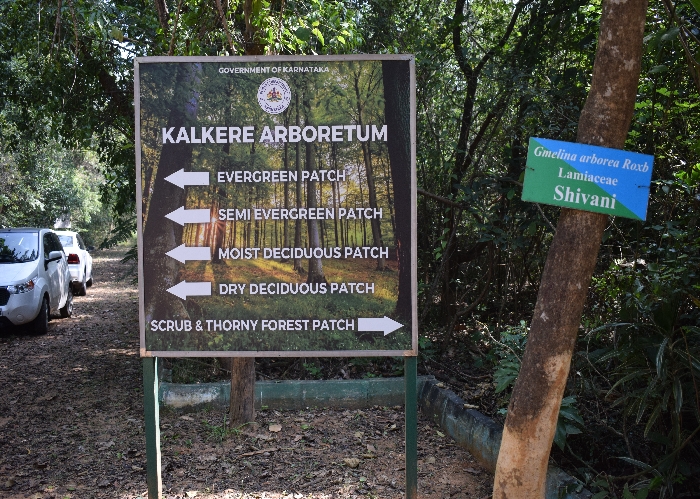
Mr. Reddy who now heads the NGO Bangalore Environment Trust (BET) took a number of activists and journalists around the Arboreturm on Sunday (December 19). Over 40 years of dedicated work has turned the land into a green space the parallel of which the city does not have. The Forest Department designated five different patches, namely 1-Evergreen, 2-Semievergreen, 3-Moist Deciduous, 4-Dried deciduous, and 5-Thorny and Scrub forest. According to Mr. Vishal Patil, Assistant Conservator of Forests, the Department periodically monitors and documents the average height and girth of trees and maintains the data. All trees bear species nameplates. Local Kannada names are also provided below the botanical names. Well marked walking trails guide the visitors inside the Arboretum. An Andaman paduka tree stands 85 feet tall. A Forest Watcher keeps watch over the place which is fenced with a compound wall.
Patil says the trees were planted between 1980 and 1999 and thereafter the forest was left to itself. Now the old trees decay and fall and creepers twine around the branches and allow rabbits, snakes and birds to create their own homes, be it in stems or branches. One could observe giant spiders weaving their cobwebs spanning the entire width of the corridors meant for visitors’ movement. Trees share their produce with a wide variety of wasps, moths, termites, bumblebees, birds and beetles and mammals. Patil says the forest is never irrigated but collects its own rainwater. It generates its own manure out of the leaves, twigs and bark falling to the forest floor. The Forest Department maintains an outpost to keep watch against intruders.
Reddy reminisces that he was ably assisted by Forest Officer Srinivas, Forest guard Balakrishna and Forest Watcher Arokyaswamy. In fact, the activist who gathered last Sunday felicitated Forest Watcher Arokyaswamy who dedicated 40 years of life to guard the space and see it turn into an urban forest. Dr. Keshav Murthy, an eminent taxonomist has even identified and catalogued all the species planted in Kalkere.
NGO activists are pondering if the Arboretum could be opened for educational tours of students with expert guides providing information on trees and their preservation.
.jpg)




