.jpg)


.jpg)

 English daily published in Bengaluru & Doha

The 'Switch' To Disaster
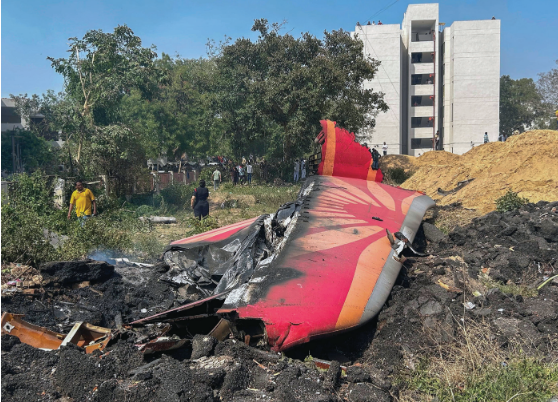
New Delhi: Seconds before Air India flight 171 crashed while ascending from Ahmedabad, the fuel control switches of both its engines were cut off, a preliminary investigation report said on Saturday, suggesting a catastrophic pilot error in the cockpit of the Boeing 787 Dreamliner.
A 15-page preliminary investigation report into the disaster revealed fuel- control switches of the two engines moved from the "run" to the "cutoff" position, within the space of one second, leading to immediate loss of altitude. In the cockpit voice recording, one pilot is heard asking the other why he cut off the fuel.
The other denied having done so. The report by Aircraft Accident Investigation Bureau (AIIB), released early on Saturday, neither con- cluded any reason for the switches moving nor apportioned explicit blame for the crash. It also did not identify the pilots in the voice record- ing. But it also said no fault was found in the aircraft, leaving only the possibility of pilot error as the cause.
At the controls was First Officer Clive Kunder, 32, while Sumeet Sabharwal, a veteran with 30 years of experience at Air India, was the senior cockpit oc- cupant in command monitoring the flight.
The report, however, referenced a 2018 airworthi- ness bulletin by the US Federal Aviation Administration that said fuel switches had been installed on Boeing 737s, a smaller model, "with the locking feature disengaged".
The locking mechanism was similar on various Boeing aeroplane models, including certain 787s, it said. It wasn't immediately clear if this had any link to the accident. The report did not provide any clues to why and by whom the two fuel switches were moved to a cut-off position as the plane nosed into the air, starving the two engines of the thrust needed for the lift. It ruled out any bird hit or fuel contamination.
According to a chronology laid out in the report, both fuel cutoff switches moved from RUN to CUT- OFF, one second apart, almost immediately after takeoff. Ram Air Turbine (RAT) pump was deployed to supply hydraulic power as both engines fell below the minimum idle rate. About 10 seconds later, Engine 1 fuel cutoff switch moved to its so-called RUN position, followed by Engine 2 four seconds later.
The pilots managed to relight both engines, but only Engine 1 recovered while Engine 2 failed to build up enough power again to reverse decelera- tion. One of the pilots is- sued a "Mayday, Mayday, Mayday" distress call, but before air traffic controllers could get a response about what had gone wrong, the plane crashed just outside the Ahmedabad airport.
The time between the take- off and the crash was only 32 seconds. The ill-fated flight was commanded by Sumeet Sabharwal, 56, a veteran with 30 years of experience at Air India. His co-pilot was Clive Kunder, 32, who had 3,403 hours of total experi- ence, with 1,128 hours on the Dreamliner. Kunder was the pilot fly- ing, while Sabharwal was the pilot monitoring.
The crew had passed pre-flight breathalyser tests and were seen at the gate on CCTV before they took off, the report adds. The June 12 accident was India's worst aviation disaster in almost three decades and the industry's deadliest in 11 years, as well as the first fatal accident involving a Boeing Dream- liner.
"The aircraft achieved the maximum recorded airspeed of 180 Knots IAS at about 08:08:42 UTC (13.38 IST) and immediately thereafter, the Engine 1 and Engine 2 fuel cutoff switches transitioned from RUN to CUTOFF position one after another with a time gap of 01 sec," the report said. "In the cockpit voice recording, one of the pilots is heard asking the other why did he cutoff.
The other pilot responded that he did not do so," it said. Almost immediately af- ter the plane lifted off the ground, CCTV footage shows a backup energy source called a ram air turbine had deployed, indicating a loss of power from the engines. There were 230 passen- gers on board -- 15 in the business class and 215, including two infants, in economy class. (PTI)

.jpg)
.jpg)
.jpg)