.jpg)


.jpg)

 English daily published in Bengaluru & Doha

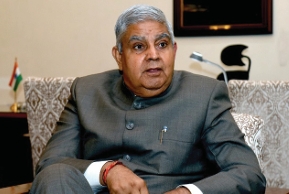
Surprise exit caps a tenure riddled with friction...
Bengaluru: Jagdeep Dhankhar’s abrupt resignation as Vice President on Monday has left political circles buzzing, but perhaps it should not come as a surprise. His tenure as the Chairman of the Rajya Sab ha was anything but smooth, punctuated by high-voltage confrontations not just with the Opposition but also with members of his own ruling alliance.
Whether it was these internal frictions that finally compelled him to put down his papers remains a matter of conjecture, but the signs had long been evident. From the outset, Dhankhar appeared more combative than conciliatory, particularly in his pointed critiques of the judiciary. His repeated attacks on the collegium system sparked fierce resis tance from the Opposition benches, with senior Congress figures like Mallikarjun Kharge and Jairam Ramesh accusing him of attempting to undermine the independence of the judiciary.
His remarks routinely triggered uproar in the Upper House, forcing adjournments and walkouts. His tenure carried over the bitterness from his days as West Bengal Governor. Dhankhar’s sparring matches with TMC MPs, especially Derek O’Brien, became almost a routine feature in Parliament. He pulled up TMC lawmakers for frequent disruptions, with several suspensions to his name, fuelling his image as a disciplinarian who was unwilling to broker peace.
Yet, the friction was far from limited to Opposition benches. Within the NDA, Dhankhar courted controversy by publicly locking horns with former BJP MP Subramanian Swamy. The Vice President did not shy away from confronting Swamy when the latter openly criticised government decisions or judiciary-related matters, signalling his readiness to take on voices within the ruling coalition.
The strain was also visible during debates on contentious issues like the Uniform Civil Code. Dhankhar’s sharp rebukes of JD(U) MPs, who op posed the Centre’s moves, caused unmistakable dis quiet among NDA ranks, reflecting a widening fault line within the alliance. Perhaps most tellingly, even voices within the BJP were uncomfortable with Dhankhar’s frequent targeting of the judiciary.
Senior leader Sushil Modi publicly urged a more measured approach, advocating dialogue over confrontation – a rare instance of intra-party disagreement that pointed to Dhankhar’s increasingly isolated position. While the official reason for his resignation is yet to be revealed, it is hard to overlook the mounting political strains that marred his tenure.
Whether driven by principle or provoked by pressure, Dhankhar’s exit marks a dramatic end to a tumultuous stint at the heart of India’s parliamentary politics.
.jpg)



.jpg)