.jpg)


.jpg)

 English daily published in Bengaluru & Doha

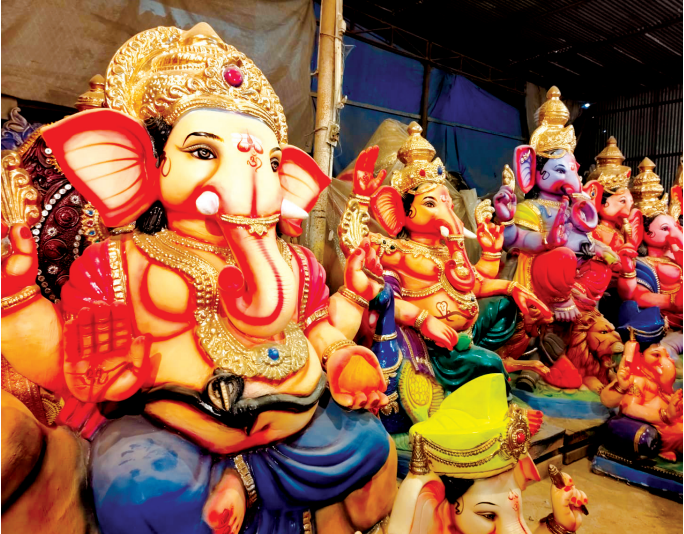
Eco-push, ban fail to oust PoP idols froma stalls
Eco-friendly festivities face challenges as clay idols struggle to find a space in PoP rush; devotees stuck between affordability and responsibility
Bengaluru: As Ganesh Chaturthi draws near, Bengaluru’s streets are bustling with devotees carrying steel plates, rice, and kumkum in search of the perfect idol for their home for celebrations. Along the Rashtreeya Vidyalaya Road, stalls are lined with GowriGanesha idols crafted from clay.
However, a News Trail visit revealed the rampant sale of Plaster of Paris (PoP) idols, despite a clear ban by the Bruhat Bengaluru Mahanagara Palike (BBMP). The BBMP had earlier issued strict guidelines urging eco-friendly celebrations, clearly stating that the manufacture or sale of idols made of PoP or other hazardous material would attract criminal cases.
Yet enforcement appeared weak on the ground. Vignesh, a vendor, admitted that his idols were made with a mix of clay and PoP. “Clay idols crack easily, but PoP holds the structure firm. They are also lighter,” he said, pointing to several large idols purchased in bulk for community celebrations.
Vignesh claimed to have already sold around 150 idols. Another seller was overheard telling a customer, “If you go further down, you will find idols of PoP.” The remark immediately drew questions from the customer about why such idols were still being sold despite the ban. Sellers insisted that demand drives the trade.
“People do not want to buy clay idols because of the cost and the dull colouring. They don’t find them attractive,” said Anand, who instead sells ecofriendly idols made from red clay and cow dung. His family-run stall has sold 30-40 idols within a week, with prices ranging from Rs 800 to Rs 12,000.
“The idols are dried and painted with watercolours,” added his wife, Swapna, stressing their eco-friendly nature. Anand further noted that many buyers could not distinguish between PoP and clay idols, highlighting the need for greater public awareness. Despite the popularity of PoP idols, a section of citizens consciously opted for clay.
“This is more organic. We will immerse it in a bucket at home so it doesn’t harm the environment,” said Shashank, while selecting a clay idol with minimal colours. A father and son were spotted carrying eco-friendly clay idols of both Ganesha and Gowri.
“We bought them for Rs 1,500. For us, it’s not just about the cost, but about ensuring we don’t add to environmental pollution,” said Shailendra, emphasising the importance of setting an example for his son and future generations. Concerned citizens warn that idols made of PoP, coated with synthetic paints, along with thermocol and plastic decorations, release toxic chemicals and choke water bodies during Visarjan (immersion), depleting oxygen levels.
They urge the public to embrace eco-friendly alternatives such as clay, papier mache, cow dung, or rice flour idols to celebrate responsibly. As the city gears up for festivities, the choice of idol, eco-friendly or not, will decide whether tradition can coexist with sustainability.




.jpg)
