.jpg)


.jpg)

 English daily published in Bengaluru & Doha

Bail for some... Bars for others
Swift relief for 'polarising voices' versus prolonged detention for protest leaders exposes deep fault lines in the justice system
Bengaluru/New Delhi: In any constitutional democracy, the rule of law must function with both rigour and fairness. Recent decisions surrounding the 2020 Delhi riots case have reignited debates about justice, pretrial incarceration and the consistency of legal stan dards.
The continued denial of bail to Sharjeel Imam and Umar Khalid and seven others – accused of conspiracy, incitement and orchestrating violence – sits uneasily beside other instances where those accused of incendiary acts faced swifter relief or limited coercive action.
A few days ago, a bench of Justices dismissed the bail pleas of Sharjeel Imam, Umar Khalid, Mohd Saleem Khan, Shifa Ur Rehman, Athar Khan, Meeran Haider, Abdul Khalid Saifi and Gulfi sha Fatima.
Denying bail to nine persons in the "larger conspiracy" case of the riots, the high court had ruled that "conspiratorial" violence under the garb of dem onstrations or protests by citizens cannot be allowed.
Their speeches, mobilisation efforts and digital communications were cast as deliberate provocations during the anti-CAA protests. The court emphasised that freedom of expression does not extend to sedition or incitement.
Yet, more than five years on, neither has seen a trial conclude. Amnesty International has called this “a big blow to the right to peaceful protest”, noting that lengthy pre-trial detention under stringent laws like the Un lawful Activities (Preven tion) Act (UAPA) effectively punishes without conviction.
The Supreme Court itself has recently observed that the fundamental principle of bail being the rule and jail the exception appears “forgotten in recent times”.
Justice Abhay S. Oka, in another ruling, reminded lower courts that bail must not be treated as a privilege granted sparingly, especially under laws such as UAPA where the burden of proof is reversed.
These remarks reflect a growing unease with how preventive detention has become the default in politically sensitive cases.
How others escaped scot-free
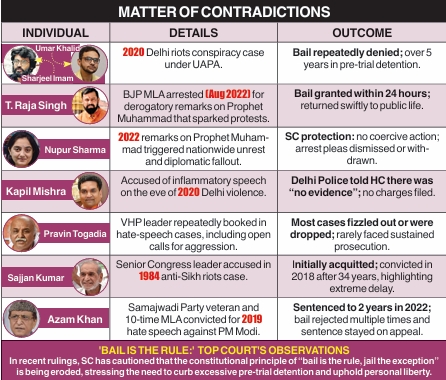
Contrast this with cases involving powerful figures accused of inflammatory rhetoric. In August 2022, BJP MLA T. Raja Singh was arrested over derogatory comments on Prophet Muhammad that sparked violent protests.
He was granted bail almost immediately, returning swiftly to public life. Around the same time, former BJP national spokes person Nupur Sharma’s televised remarks triggered nationwide unrest and international diplomatic fallout.
Yet, the SC directed that no coercive action be taken against her, effectively shielding her from arrest even as petitions seeking accountability were withdrawn or dismissed.
Similarly, Kapil Mishra, accused in multiple public interest petitions of making provocative speeches on the eve of the 2020 Delhi riots, has never faced seri ous investigation.
Delhi Police told the HC they had “no evidence” linking him to the violence – a claim widely questioned by analysts who point to video recordings and the timing of his remarks.
Likewise, Pravin Togadia, a vocal Hindutva ideologue, has faced dozens of hate speech cases with few tan gible legal consequences.
Many of these allegations involve open calls for aggression or exclusion – actions not dissimilar intone, if not in medium, to what Imam and Khalid are accused of.
Selective enforcement?
Such disparities deepen perceptions of selective enforcement. When some face the full weight of anti terror legislation while others benefit from procedural delay or judicial restraint, the notion of equality be fore law begins to fray.
Historical cases reinforce this concern: Sajjan Kumar’s conviction for his role in the 1984 anti-Sikh riots came over three decades late, af ter an initial acquittal, while Jagdish Tytler only saw charges framed this year.
In the meantime, victims and their families endured decades of stalled justice. These cases are not identical – they differ in evidence, context and conse quence.
But the contrasting pace and severity of state response cannot be ig nored. Justice must be impartial, neither lenient nor vengeful. The state’s duty is twofold: to prosecute communal violence with resolve and to ensure that prosecution does not morph into persecution.
Lengthy pre-trial detention, especially when trials drag on for years, undermines both civil liberties and faith in democratic in stitutions.
As India matures as a re public, its judiciary must not merely adjudicate facts but embody fairness.
Cases like those of Imam, Khalid, Sharma, Mishra, Kumar, Togadia and Tytler are more than legal disputes – they are tests of whether justice in India can truly be blind to faith, fearless in pursuit and balanced in delivery.
.jpg)



.jpg)