.jpg)


.jpg)

 English daily published in Bengaluru & Doha

Nobel Prize in Physics goes to 3 scientists whose work advanced quantum technology
Stockholm
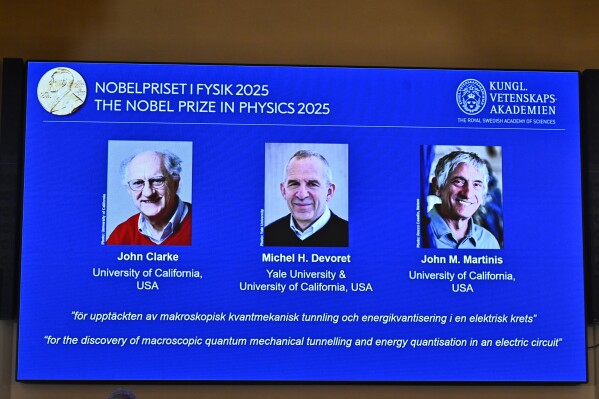
John Clarke, Michel H. Devoret and John M. Martinis won the Nobel Prize in Physics on Tuesday for research on seemingly obscure quantum tunnelling that is advancing digital technology.
Clarke, 83, conducted his research at the University of California, Berkeley; Martinis at the University of California, Santa Barbara; and Devoret at Yale and also at the University of California, Santa Barbara.
“To put it mildly, it was the surprise of my life,” Clarke told reporters at the announcement by phone after being told of his win. “Our discovery in some ways is the basis of quantum computing. Exactly at this moment, where this fits in is not entirely clear to me.”
However, speaking from his cellphone, Clarke added: “One of the underlying reasons that cellphones work is because of all this work.'
The 100-year-old field of quantum mechanics deals with the seemingly impossible subatomic world where switches can be on and off at the same time and parts of atoms tunnel through what seems like impenetrable barriers. The prize-winning trio's work helped take that into the larger world, where it has the potential to supercharge computing and communications.
What the three physicists did “is taking the scale of something that we can't see, we can't touch, we can't feel and bringing it up to the scale of something recognisable and make it something you can build upon,” said Physics Today editor-in-chief Richard Fitzgerald, who in the 1990s worked in the field on a competitor's group.
Nobel announcements continue with the chemistry prize on Wednesday and literature on Thursday. The Nobel Peace Prize will be announced on Friday, and the Nobel Memorial Prize in economics on Oct. 13.