.jpg)


.jpg)

 English daily published in Bengaluru & Doha

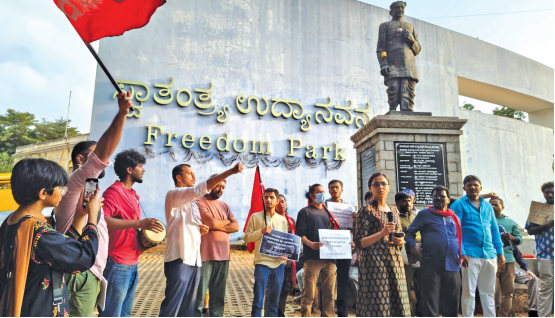
Activists oppose resource exploitation, threat to Adivasis
Bengaluru: "We are speaking out on these issues because we have seen a clear pattern: whenever the government seeks to acquire land for industrial purposes and faces resistance, it deploys state forces – police or paramilitary – to suppress the people. That is why we oppose this,” said Aratrika of the All India Students’ Association (AISA).
She highlighted the concerns raised by hundreds of activists, environmentalists, students, teachers, trade unionists, and citizens across Karnataka, who have been vocal against the militarisation and corporate exploitation of Adivasi lands in India. Activists point to ongoing operations such as Operation Kagaar in Chhattisgarh, as well as similar incidents in Bastar, Devarahalli, Ladakh, Manipur, and Nagarhole, as evidence of systematic displacement, land grabs, and violations of tribal rights.
They argue that these interventions are often justified under the guise of antiNaxal campaigns or conservation efforts, but in reality serve corporate and state interests. “In the name of protecting tigers, Adivasis are being targeted and shot. Jal, Jangal, Jameen are rightfully ours, not the government’s,” said Shivu of the Jenu Kuruba Samudaya in Nagarhole.
He criticised the superficial concern of urban populations for forests, which frequently overlooks the communities that have lived in and safeguarded them for generations. For Harish Gopi of AISA, operations like Kagaar are part of a broader framework to systematically oppress tribal populations. “Corporates exploit people for labour, land, and resources.
Operation Kagaar strips communities of their Jal-Jangal-Jameen and basic dignity, enslaving them for the benefit of a privileged few. It is every citizen’s democratic duty to oppose this,” he asserted. Activists also condemned the state for violating legal safeguards during anti-Naxal operations. Comrade Nagaraj Pujjar of CPI (ML) Liberation stated, “We must protest against Project Kagaar in Chhattisgarh and the violence inflicted on Adivasis.
They are killed in so-called encounters and labelled as Maoists. This must stop!” He added that groups like the RSS and Sangh Parivar pursue a broader political agenda to erase Adivasi cultures, while those defending tribal rights are often branded anti-national. Reflecting on the human cost of resistance, Sachin of AISA marked the 12 October anniversary of Prof. G.N. Saibaba’s death, describing it as a stark reminder of the price paid for opposing state violence.
“Prof. Saibaba spoke out against Adivasi killings, faced incarceration and state brutality, and ultimately died because of it. We must continue the struggle of resistance heroes like Saibaba, Pandu Narote, and Father Stan Swamy,” he said. Economic and environmental exploitation was another pressing concern.
S.M. Maari of Pragatipara Karnataka Kattada Karmika Mathu Eethara Nirmana Union warned that Operation Kagaar facilitates the sale of India’s natural resources to crony capitalists. Leon of the Adivasi Sangharshan Morcha emphasised the need to amplify tribal voices in the mainstream. “These are some of the most isolated and marginalised communities in the country.
Many are still subjected to bonded labour even today in Tamil Nadu and Coorg because they lack socio-economic capital. We must fight this injustice and spread awareness,” he said. In unison, the activists insist that operations like Kagaar are not isolated incidents but part of a systematic attempt to displace Adivasis, exploit resources, and suppress dissent.
They assert that protecting Jal, Jangal, and Jameen is inseparable from the struggle for justice, dignity, and democratic rights for marginalised communities.




.jpg)
