.jpg)


.jpg)

 English daily published in Bengaluru & Doha

Environmental impact minimal': Engineers defend tunnel project
Bengaluru
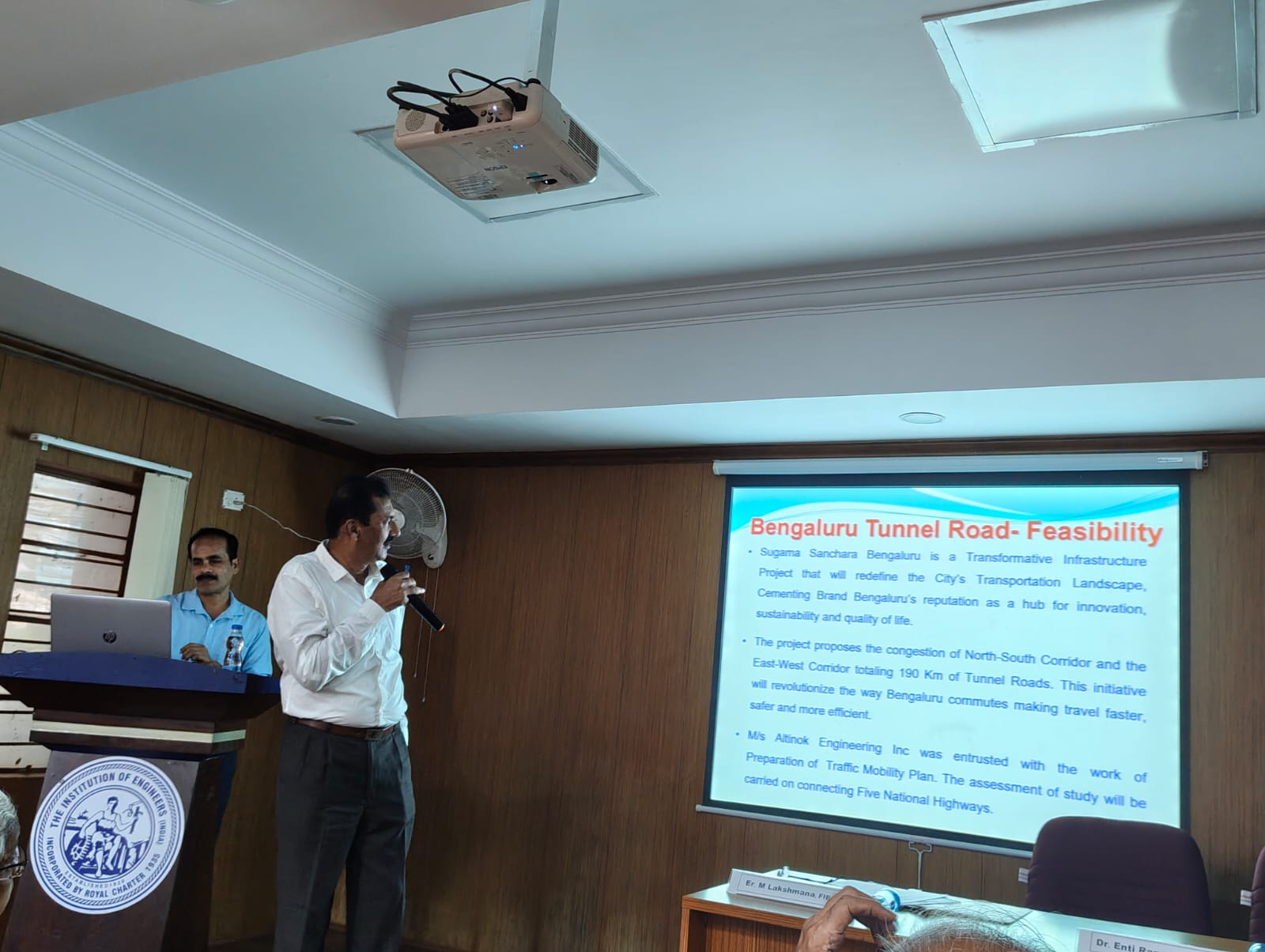
“There are several metro tunnels in Bengaluru, but have you seen any of them causing damage to the environment or the infrastructure above ground? Take, for instance, the metro station near Vidhana Soudha,” said M. Lakshmana, Fellow of the Institution of Engineers (FIE), during an expert discussion on the proposed Bengaluru tunnel roads held at the Institution of Engineers (India), Karnataka State Centre (KSC), on Tuesday.
The session, led by Lakshmana, Secretary of the Institution of Engineers (India), KSC, along with Dr Enti Ranga Reddy (FIE) and Dr N. Chikkana (FIE), was attended by concerned citizens, engineers, and subject specialists. Engineers evaluated the four-phase, 190 km proposed tunnel road network in Bengaluru, designed to ease traffic congestion across the city’s north, south, east, and west corridors.
In Phase 1, two major corridors are planned: the 40.5 km North–South corridor from Airport Road (Bellary Road–Esteem Mall Junction) to Silk Board Junction, estimated at ?18,000 crore, and the 52 km East–West corridor from K.R. Puram to Mysuru Road, estimated at ?24,000 crore. The project will follow the Build, Operate, and Transfer (BOT) model, with private players taking responsibility for investment and maintenance.
Engineers also examined feasibility, projected costs, necessary approvals, comparisons with other tunnel projects in India, and the project’s broader benefits to urban mobility. It is expected to facilitate smooth and uninterrupted travel, thereby reducing pollution, accidents, and delays at traffic junctions. Additionally, it is anticipated to lower maintenance costs, with commuters required to pay a toll of ?20 to use the tunnels.
Although officials and project engineers maintain that the tunnel road plan will help decongest Bengaluru, it has faced criticism over its feasibility and potential environmental impact. “You cannot say that it would not affect the environment, especially when one of the tunnels is planned to pass directly beneath Lal Bagh. This will likely disturb the underground aquifers,” a geologist cautioned.
Responding to this, Lakshmana said the ecology of Lal Bagh would remain unaffected, as there would be no exit point in that section according to the Detailed Project Report (DPR). He further explained that, with guidance from geologists, the tunnel alignment would be planned to pass through zones without major rock formations beneath Lal Bagh.
Concerns were also raised about the possible exclusion of two-wheelers and autorickshaws from using the tunnel. However, engineers termed these fears unfounded, clarifying that only heavy vehicles would be restricted. “The Union Transport Minister Nitin Gadkari has emphasised that tunnel roads will be game changers, especially for Bengaluru,” Lakshmana said, adding that the proposal was initiated on the suggestion of the Union Ministry.



.jpg)

