.jpg)


.jpg)

 English daily published in Bengaluru & Doha

When domestic cricket shuts out its own audience
The ongoing Vijay Hazare Trophy, one of India’s most prestigious domestic one-day tournaments, should have been a celebration of cricket’s democratic spirit – a stage where established stars and emerging talents share the same field, and where fans reconnect with the grassroots of the game. Instead, it has exposed a troubling disconnect between the administrators of Indian cricket and the very public that sustains it.
This season, the tournament is being staged across a scatter of venues nationwide, many of them chosen with little apparent logic or transparency. More puzzling, however, is the arbitrary manner in which matches are selected for broadcast. While a handful are televised or streamed, several high-profile fixtures – including those featuring Virat Kohli and Rohit Sharma – have inexplicably been left out. One struggles to understand the criteria guiding these decisions, or the justification for sidelining matches involving the two most recognisable figures in Indian cricket.
The irony is difficult to miss. The primary reason public attention gravitates towards the Vijay Hazare Trophy, beyond its competitive value, is precisely the participation of such icons. Their presence lends the tournament visibility, narrative and emotional investment. To deny broadcast access to their matches is to undercut the very interest that sustains the competition’s relevance beyond a niche following.
Compounding the problem is the restriction on spectators. With matches being held at Centres of Excellence or controlled venues, entry is limited to officials and pass-holders. Ordinary fans – those who have followed the game loyally across generations – are barred from the stands. In effect, the public is excluded twice over: first from physical access to the stadiums, and then from televised or digital access to the action itself.
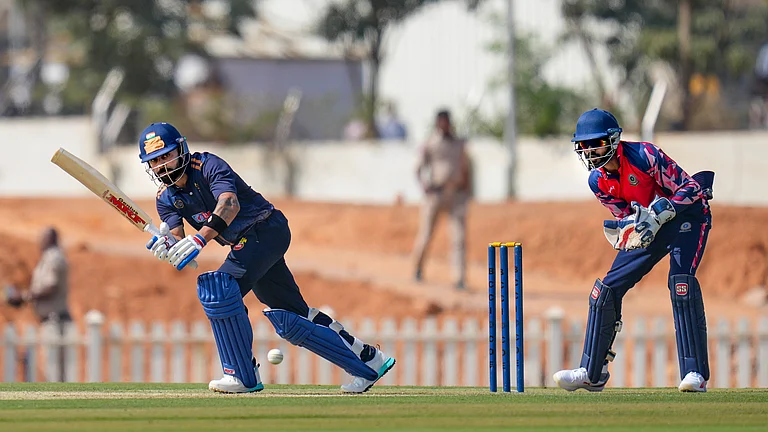
The consequences are evident. Beyond a handful of still photographs circulating online, there is little visual record of these matches. Even standout performances vanish into statistical obscurity. Devdutt Padikkal’s monumental innings – a huge 147 runs in a successful chase of over 400 against Jharkhand – received scant visibility, despite being the kind of feat domestic cricket is meant to showcase. When performances of such scale fail to reach audiences, the developmental and inspirational purpose of domestic tournaments is weakened.
This raises larger questions about governance and priorities within Indian cricket. Broadcasting is not merely a commercial exercise; it is a public service in a country where cricket occupies a unique cultural space. Transparency in broadcast selection, consistency in coverage, and respect for viewership demand are essential components of sporting administration. The current ad hoc approach risks alienating fans who feel taken for granted.
There are only two defensible paths forward. Either allow spectators into stadiums in a regulated manner, restoring the organic connection between players and public, or ensure comprehensive and equitable broadcasting of matches – particularly those featuring marquee players. To do neither is to deny fans any meaningful engagement at all. Indian cricket thrives because of its people: their patience, loyalty and emotional investment. Domestic tournaments are not mere logistical exercises; they are cultural institutions. If the Board of Control for Cricket in India truly seeks to strengthen the sport’s foundation, it must remember that access – visual, physical and emotional – is not a privilege but a responsibility.
.jpg)
.jpg)
.jpg)
.jpg)
.jpg)
.jpg)