.jpg)


.jpg)

 English daily published in Bengaluru & Doha

Maharashtra civic polls: A positive signal for Congress
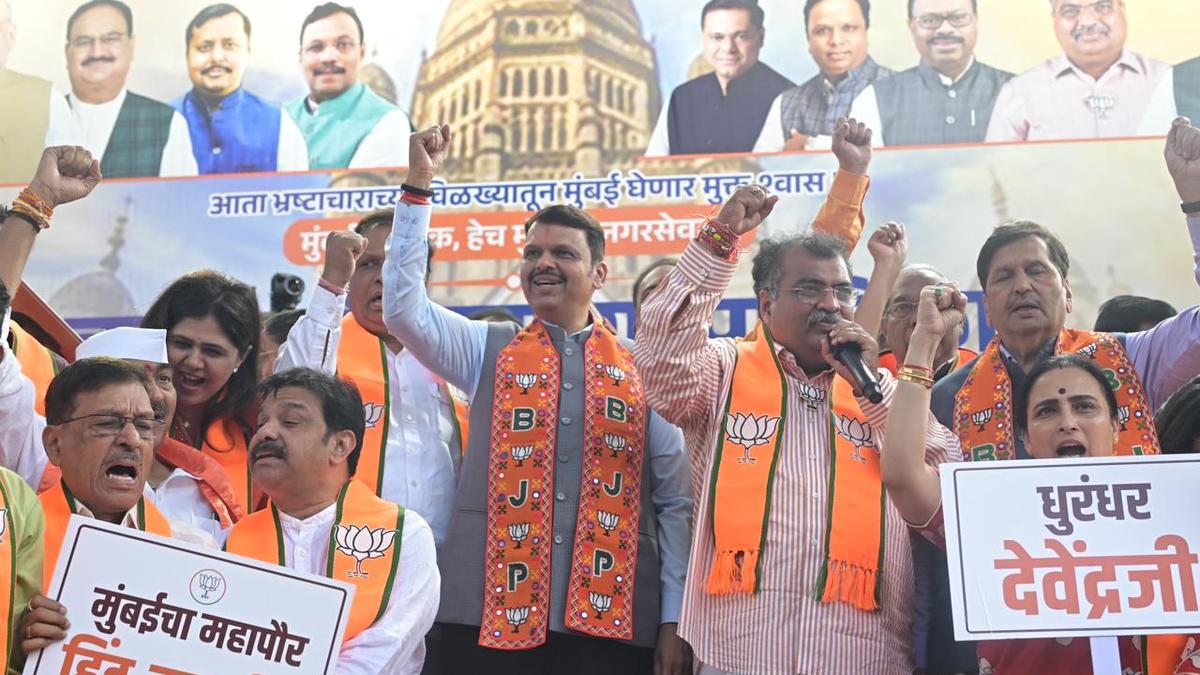
The Maharashtra civic election results delivered a sweeping victory to the Bharatiya Janata Party (BJP), which emerged as the single largest force across the state. This outcome was largely on expected lines. The BJP’s capture of Mumbai, a Shiv Sena bastion for over two decades, underlined the scale of its success. Yet, beneath this dominant performance lies a quieter political message for the leadership of India’s grand old party, particularly for Rahul Gandhi and party president Mallikarjun Kharge.
While the BJP dominated the headlines, the Congress managed a respectable performance despite contesting the elections independently. The party fought only 528 of the total 2,869 seats across municipal corporations but succeeded in winning 317 seats. This placed Congress third overall, behind the BJP, which won 1,441 seats, and the Eknath Shinde-led Shiv Sena with 408 seats.
In Mumbai, Congress failed to make a significant impact. The alliance of Uddhav Thackeray’s Shiv Sena faction and Raj Thackeray’s Maharashtra Navnirman Sena (MNS), which sought to capitalise on Balasaheb Thackeray’s legacy, also failed to convert sentiment into electoral gains. Similarly, both factions of the Nationalist Congress Party (NCP) struggled to secure victories even in their traditional strongholds such as Pune and Pimpri-Chinchwad. The BJP’s success was particularly notable as it contested the civic elections alone for the first time since 1999.
It registered commanding wins in Mumbai, Navi Mumbai, Pune, Nashik, Nagpur, Panvel and Kalyan-Dombivli, reinforcing its organisational strength at the grassroots level. For Congress, the decision to fight independently came after the fragmentation of the Maha Vikas Aghadi, amid shifting alliances among the Shiv Sena and NCP factions. Although the party could not challenge the BJP’s dominance, its ability to secure a substantial number of seats without allies suggests that its core vote base in Maharashtra has not eroded over the years.
The results therefore send a mixed but meaningful message to the Congress leadership. While the party is no longer the principal challenger to the BJP in the state, it has outperformed several regional forces and demonstrated electoral resilience.
In a political landscape marked by frequent splits and realignments, Congress’s standalone showing offers a measure of reassurance and a foundation to rebuild its influence in Maharashtra’s local politics.
However, it also signals important considerations ahead of crucial Assembly elections, particularly in Kerala, where Congress remains the principal challenger; in Tamil Nadu, where it allies with the DMK but faces uncertainty over the final alignment; and in West Bengal, where the party has been virtually wiped out. In this context, the Maharashtra performance can instil a semblance of confidence. Finally, in Assam, Congress still retains a presence and a strong leader in Gaurav Gogoi.
.jpg)
.jpg)
.jpg)
.jpg)
.jpg)
.jpg)