.jpg)


.jpg)

 English daily published in Bengaluru & Doha

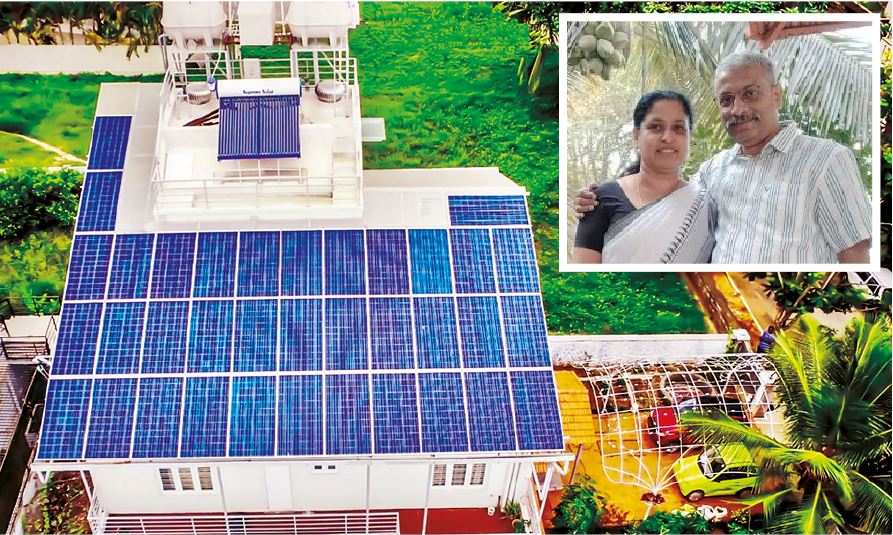
Engineer builds self-sustaining home with minimum carbon footprint in Jigani
Bengaluru
At a time when environmental sustainability has become more important than ever, few have shown greater commitment to it than Neel Mathews. Mathews, who studied engineering in his youth, began building his self-sustaining home in 2013 on a plot of land he purchased in Jigani. The house is almost entirely self-reliant in terms of resources: it does not use piped water, generates its own electricity, cools its own air and manages all waste on site. Even the compound wall doubles as a fully functional fish tank.
“The biggest contribution of the architect was that he designed the structure in such a way that my modifications could be accommodated,” Mathews said, referring to the process of working with an architect who had previously built only conventional homes. Mathews said his concern for ecological balance began in childhood. In order to earn some extra money, he would catch frogs and sell them, as their meat fetched good prices in the export market.
As more people began doing the same, the frog population declined sharply and insect numbers rose. That was when he realised the harm such practices could cause to nature. In that spirit, he later named his company Frogs and Cashews, through which he develops eco-friendly solutions for homes with his wife, after spending several years working in the technology sector.
“Certainly, I am the driving force behind it. She prefers the regular path. To sustain our life together, I had to convince her about what I was doing. She asks a hundred questions, and I have to find the answers to satisfy her. Sometimes I have to demonstrate things in practice before she is convinced,” Mathews said.
He began constructing the house as a model to demonstrate how city dwellers could incorporate sustainable ideas into their homes. For this reason, he built it on a 30x40 ft plot – a typical size for a house in the city. “Certain principles guided the project. I did not want to depend on others as far as possible. Take water, for instance: if there is constant conflict over buying and supplying it, I would rather avoid that. Naturally, this approach aligns with nature.
Similarly, we do not dispose of much waste – apart from plastics and a few other items, which we send into the mainstream recycling system. Most other waste is broken down within this same land,” he said. While the project may appear complex, Mathews said every aspect functions through a system that requires little intervention from him or his wife. “Even as we speak, the termites are doing their work,” he said, referring to the natural waste management processes on the property. Although no one has replicated the entire system used in his home, some elements have inspired others to adopt similar practices.



.jpg)

