.jpg)


.jpg)

 English daily published in Bengaluru & Doha

Sowing sense: A school’s quiet learning revolution
Mangaluru
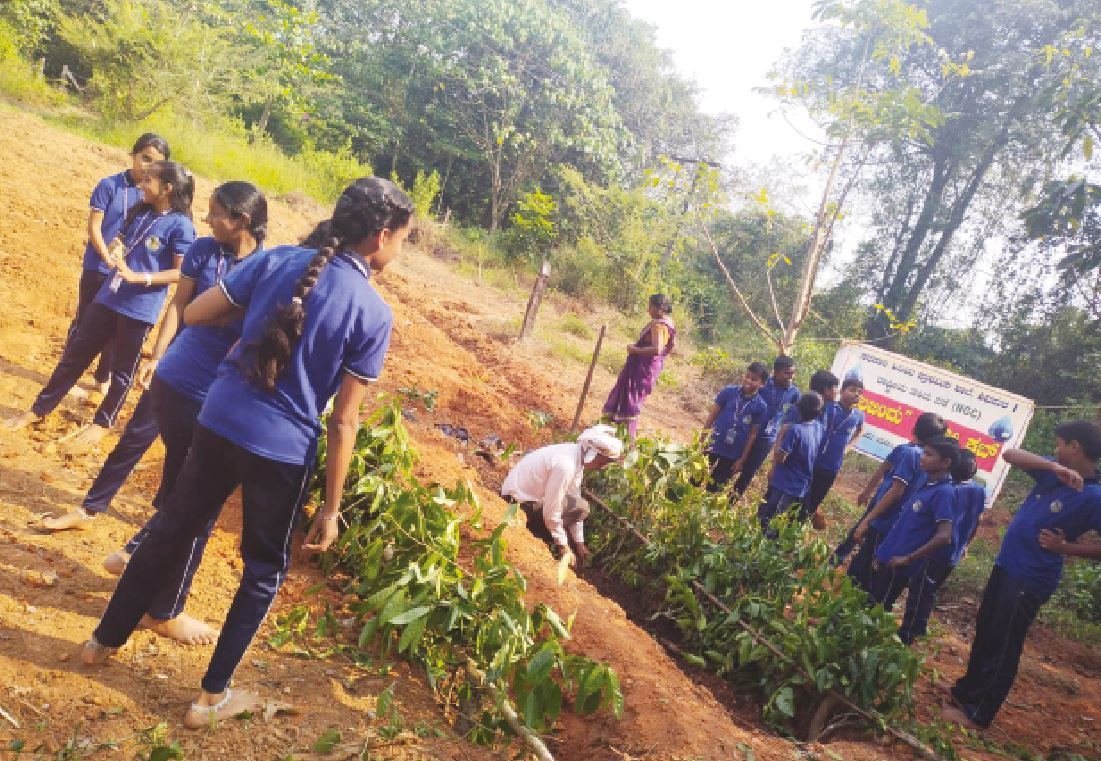
Tucked away in Hebri taluk, Shivapura 1 Government Higher Primary School is doing something many institutions only talk about; bringing real life into education. There are no big claims, no glossy banners. Yet, what is unfolding inside this modest campus is drawing attention far beyond its village. At first glance, it looks like any other government school. But spend a little time here, and the difference becomes clear. Between classrooms and corridors, there’s a stretch of green that tells a larger story, one of children learning not just from books, but from the land itself. The idea is simple: make learning meaningful. Instead of keeping education confined to theory, the school has blended it with agriculture, allowing students to understand the basics of life through practice.
What started as a small effort has now evolved into a structured activity that runs alongside academics. The school garden is not treated as an extracurricular add on. It is part of the daily routine. Students, along with teachers, step out during a fixed hour to work on the land, watering plants, clearing weeds, observing growth. There’s no compulsion, yet there is participation. Over time, it has become a habit. Crops are grown in cycles, keeping the seasons in mind. Vegetables suited for different periods are cultivated, ensuring the land is always in use.
The methods are strictly organic. There is a conscious decision to avoid chemicals, and that’s where the community steps in, parents contributing natural manure, making them silent partners in the process. Water is drawn from a well, and every drop is used carefully. There’s an underlying lesson here too of conservation and mindful use. The impact of this initiative is visible in ways that numbers alone cannot explain. Students show a different level of engagement. There is curiosity, not just compliance. Questions arise from observation, not just textbooks.
For many, this has been their first direct interaction with farming. Teachers say the change in attitude is evident. Children are more attentive, more involved, and more connected to what they learn. Attendance has improved steadily, and parents too have begun to take greater interest in the school’s activities. What’s interesting is how this learning extends beyond the campus. Several students have started replicating small gardening practices at home. Some help their parents in fields with a new sense of understanding. The gap between school and home is slowly narrowing. The produce from the garden finds its way back to the students in their meals.
It’s a full circle. What they grow is what they eat. Fresh, simple and nutritious. But more than the food, it builds a sense of ownership. The school, which has around 168 students, functions with a small team of teachers. Resources are limited, but intent is not. Support has come from unexpected quarters, former students and local stakeholders have stepped in to help with transport and basic needs, showing that when a school takes initiative, the community responds. Visitors have begun to take note. Educators from nearby regions are coming in to observe the model. Not because it is large or complex, but because it is practical and doable.
Headmistress Gulabi sees this as more than just a project. For her, it is about shaping attitudes early. “Children should understand where food comes from, and what effort goes into it,” she says. She also points out that the initiative has brought parents and alumni closer to the school. “When the community stands with the school, even small ideas grow into something meaningful,” she adds. Raghavendra Poojary, SDMC President, believes the project has strengthened collective responsibility. “This garden belongs to everyone. Parents contributing manure and old students supporting transport shows how a school can become a shared space,” he says.
Ramananda Shetty, President of the Karnataka State Primary School Teachers’ Association for Karkala and Hebri taluks, describes the effort as a model for others to follow. “Introducing organic farming at a young age builds environmental awareness naturally. Such initiatives should spread to more schools,” he notes. There has been another subtle shift. With increased activity and attention, the school itself has seen gradual improvement in its surroundings and facilities. A sense of pride seems to have taken root, not just among students, but across the community. What Shivapura 1 School has achieved may not look extraordinary at first. But in a system often criticised for being disconnected from reality, this small step feels significant. Because here, education is not just taught. It is grown.
.jpg)
.jpg)