.jpg)


.jpg)

 English daily published in Bengaluru & Doha

AI cameras change driving behaviour
Mangaluru
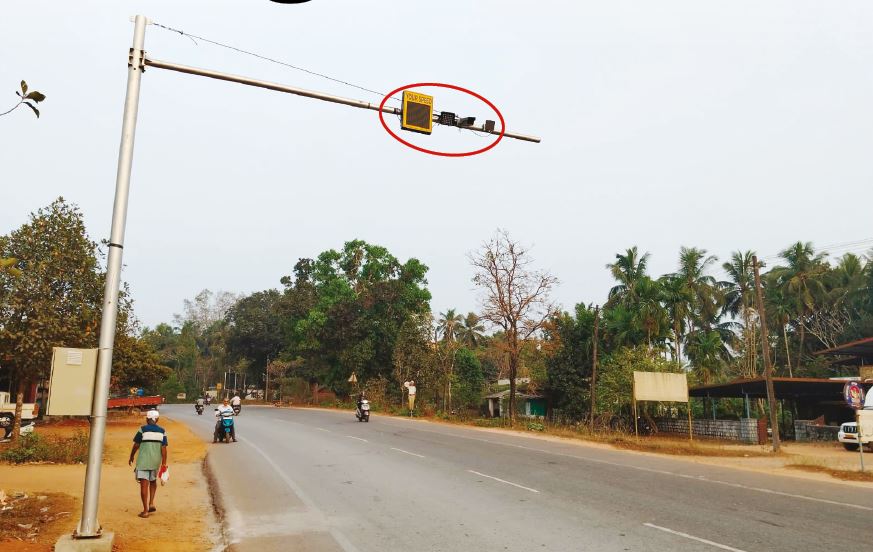
Days after the rollout of AI powered traffic surveillance at Doopadakatte on the Padubidri Karkala State Highway, the impact is already visible on the ground. What began as a technological intervention is now steadily reshaping commuter behaviour, with motorists becoming more cautious and compliance levels showing early signs of improvement. The installation of ANPR (Automatic Number Plate Recognition) cameras was initially met with curiosity and a degree of skepticism.
However, within a short span, the system has demonstrated its effectiveness. Vehicles that once slipped through unnoticed are now being tracked with precision, capturing violations in real time and leaving little scope for evasion. Local police sources indicate that several digital challans have already been generated since the system went live. Many vehicle owners, surprised by notices received directly on their mobile phones, have begun acknowledging the shift towards stricter, technology driven enforcement.
The inclusion of photographic and video evidence with each challan has further strengthened the credibility of the system, making disputes increasingly rare. For regular commuters on this stretch, the difference is noticeable. Helmet usage among two wheeler riders has reportedly increased, and instances of rash driving and signal violations have come down. “Earlier, people would slow down only if they spotted a police check ahead.
Now, there is a sense that someone is always watching,” said a local resident, pointing to a more disciplined traffic flow in recent days. Authorities believe that this behavioural change is precisely the outcome they were aiming for. Unlike traditional enforcement methods that rely on physical presence, the AI based system ensures continuous monitoring without interruption. It not only reduces the burden on traffic personnel but also eliminates the possibility of selective enforcement. The initiative is part of a larger district wide plan to introduce smart enforcement across eight identified high risk corridors in Udupi.
Officials say the Karkala stretch is serving as a pilot of sorts, and its early success could accelerate implementation in other areas. Police officials have reiterated that the objective is not merely to penalize but to prevent accidents. With Udupi district witnessing a concerning rise in road mishaps linked to negligence and rule violations, the need for such interventions has become urgent. “Technology is helping us move from reactive policing to preventive enforcement,” an officer noted.
At the same time, there is a growing awareness among the public that traffic discipline is no longer optional. The certainty of detection, rather than the severity of punishment, appears to be driving compliance. Motorists are beginning to realize that even minor violations can now be recorded and acted upon without delay. While some concerns have been raised about privacy and over surveillance, authorities maintain that the system operates strictly within legal frameworks and is aimed solely at enhancing road safety. As Karkala adapts to this new era of digital enforcement, the message is clear-roads are becoming smarter, and so must the people who use them.

.jpg)
.jpg)