.jpg)


.jpg)

 English daily published in Bengaluru & Doha

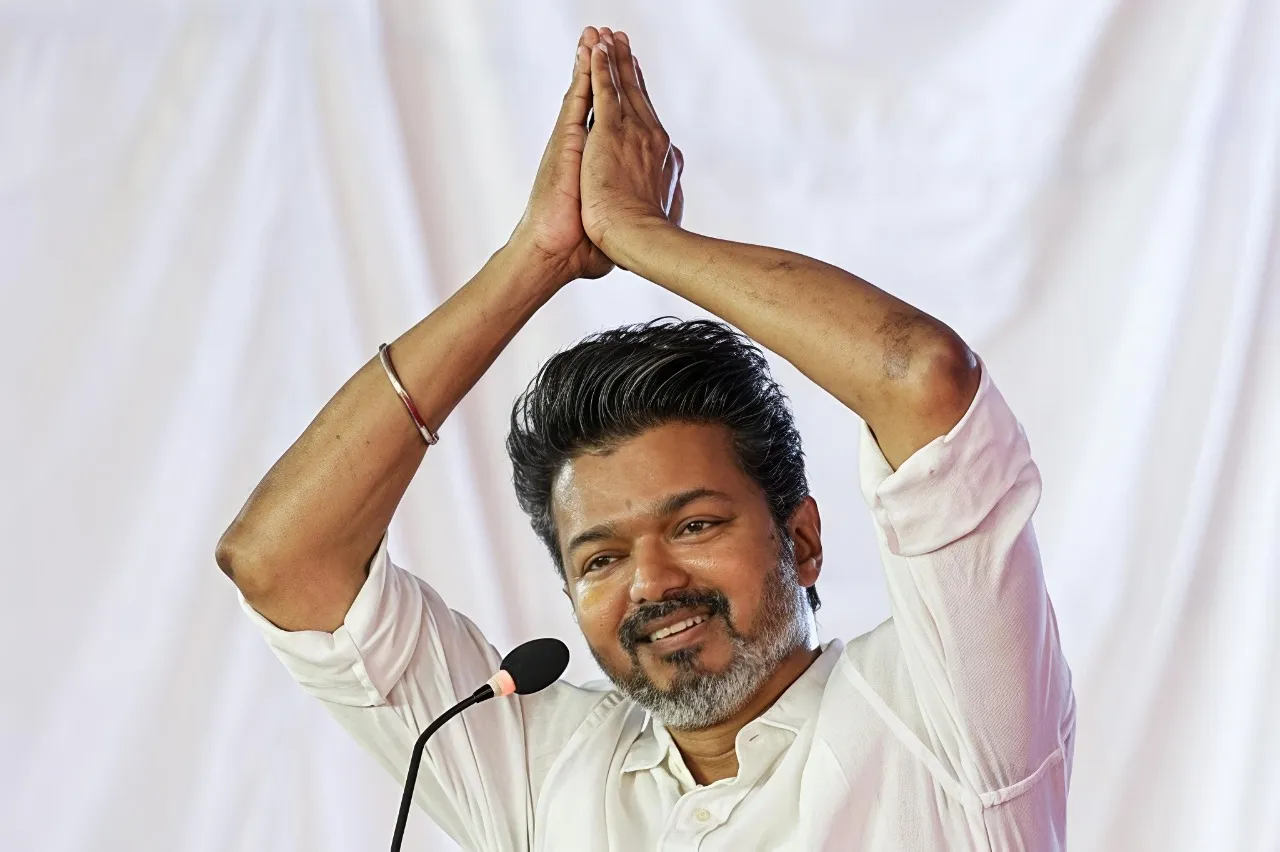
Vijay’s Entry: Tectonic Shift in TN Politics
Tamil Nadu politics enters a new era with Tamil Vettri Kazhgam leader Joseph Vijay preparing to be sworn in as the state’s chief minister on Saturday (May 9). It signals a major tectonic shift in the state which was ruled by the two Dravidian parties, almost alternatively after banishing the major players of the national polity.
Entry of Vijay and his Tamilaga Vettri Kazhgam in Fort St. George marks the end of duopoly that had come to characterise state politics following the rise of Dravidian self-respect movement which had its origin in pre-Independence period. It had germinated from writings of Periyar Ramaswamy Naicker, the fierce champion of Tamil sub-nationalism, opposition to imposition of Hindi, welfare populism mixed with appeal of celluloid heroes.
Though the DMK split with the rise of matinee idol MG Ramachandran in 1972, the ideological foundations remained firmly embedded in the same historical movement. Neither of the parties truly threatened or challenged the other’s roots and the voters oscillated between two branches of the same ideology.
Though rivalry was fierce, both knew their rivalry provided them the basic energy needed for mobilisation and content for survival. The competition between them was mainly about inheritance of the mantle of old heroes. A strong bid was made in 1979 to forge unity between them.
But they understood that the opposition space would essentially be filled by forces that would essentially represent non-Tamil ethos and instinc tively foreclosed the chapter. Rise and entry of Vijay and TMK may be an unsettling factor for Tamil politics as he threatens to nurture a vastly different environment.
It is a generational replacement as Vijay with his celluloid appeal is all likely to shift the centre of gravity of politics pursued by Dravida Munnetra Kazhagam (DMK) and its rival All India Anna Dravida Munnetra Kazhagam (AIADMK). Their mutual agreement to prevent any new ideological forces now lies in tatters.
Vijay is all likely to dethrone the traditional leaders and ideologies that have had their time and appear bankrupt of new ideas. Vijay represents a generation which no longer harbours memories of anti-Hindi agitation or feels any emo tional bonding with Annadurai, Karunandihi, MG Ramach andran or Jayalalithaa.
He is a product of digital culture that enamours vast army of youth who are swayed by new personalities and expect new welfare programmes as well as giveaways. Having come riding the crest of a massive wave of supporters, fans and followers, he will be expected to fulfill the populist promises and will be watched as to how the State finances would avert pauperisation.
.jpg)
.jpg)
.jpg)
.jpg)
.jpg)
.jpg)