.jpg)


.jpg)

 English daily published in Bengaluru & Doha

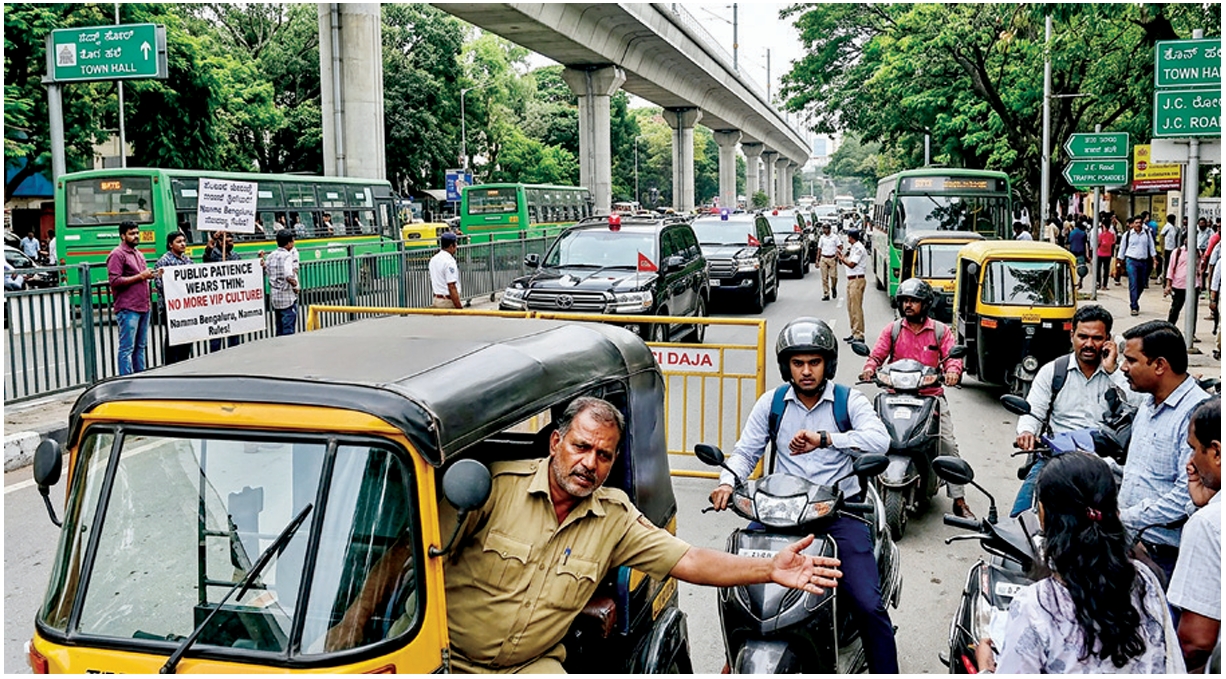
Public patience with VIP culture wears thin
Bengaluru,
Public frustration over the misuse of VIP privileges by politicians and government officials appears to be reaching a tipping point, with citizens increasingly unwilling to tolerate disruptions caused in the name of official movement. Recent incidents have highlighted growing resistance to VIP culture, as people question why the convenience of a few should come at the expense of the public.
The latest such incident was reported in Bengaluru, where a man protested after traffic was halted for the Governor's convoy while his pregnant wife, who required urgent medical attention, was left stranded on the road. The episode has reignited a broader debate on the continued prevalence of VIP culture in the country and raised a fundamental question: why should the movement of government officials take precedence over the needs and emergencies of ordinary citizens?
“VIP culture has no place in a democracy. When we say that India is a democratic republic, the fundamental principle of the Constitution is that all citizens are equal,” said Maitreyi K of the All India Lawyers Association for Justice. She argued that VIP culture is unconstitutional and runs contrary to the core values of democratic governance.
“It is unfortunate that practices such as blocking roads for VIP movement continue to persist despite being inconsistent with the principle of equality,” she said. Experts contend that such preferential treatment is particularly inappropriate when extended to government officials, whose primary responsibility is to serve the public rather than project superiority over ordinary citizens.
“In this day and age, and in a democracy, it is completely unacceptable to perpetuate VIP culture in any form, especially among government officials and elected representatives,” said Sandeep Anirudhan, convenor of Citizens' Agenda for Bengaluru. “They must remember at all times that they are public servants, not public masters.” Social activist Tanveer Ahmed stressed that every citizen in India is entitled to equal rights and that no individual should enjoy special status over others.
“In any sphere, class based distinctions are unjustified. Everybody should be treated equally; you cannot treat some people better than others,” he said. He further argued that the police should focus on serving the public rather than providing preferential treatment to VIPs at the expense of ordinary citizens. Expressing optimism about future change, Ahmed said he believes the younger generation will play a key role in challenging and dismantling VIP culture.



.jpg)
