.jpg)


.jpg)

 English daily published in Bengaluru & Doha

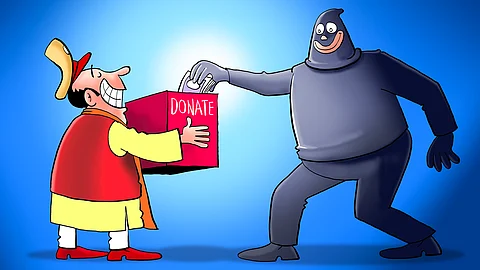
‘Shell’ parties helping bypass legalities
When 20 rebel Trinamool Congress Lok Sabha MPs decided to abandon Mamata Banerjee’s parliamentary fold, many expected them to take the familiar route travelled by the majority of defectors from various political parties across the country over the past decade to join the BJP. Instead, they chose the Nationalist Citizens Party of India (NCPI), an obscure Tripura-based registered unrecognised political party , providing the rebels a legally safer route out of the TMC while allowing the BJP to benefit from their support without immediately inducting them.
The decision of the rebel TMC faction is a careful move to bypass legalities. For the rebels, obscurity was not a liability. It was the strategy. Parliamentary rules and ensuing legal hurdles made the rebels turn to the NCPI, which offered what a stand alone rebel bloc could not: legitimacy. The BJP’s role in the unfolding drama is equally revealing.
The rebels’ consultations have largely revolved around senior BJP leaders, with several key meetings taking place at the residence of Union minister Bhupender Yadav. The NCPI route; it gave the rebels a vehicle through which they could move collectively without immediately confronting legal complications and allowed the BJP to secure parliamentary support without forcing an awkward political merger in West Bengal.
In a political scenario defined by calculations of legality, recognition and survival, obscurity itself became a form of utility for rebel TMC MPs and NCPI. The increasing trend of defections continues unabated amid indications that six to seven lawmakers of the Shiv Sena (UBT) are preparing to switch allegiance. Under the law, one cannot simply merge with a party even if they have the support of two-thirds of the MPs.
Only the original party can merge if a group has the required two-thirds strength. The NCPI plan of 20 rebel Trinamool Congress Lok Sabha MPs to merge with a lesser-known unrecognised party has striking similarities with a split in the Congress’ Arunachal Pradesh unit led by Pema Khandu in 2016. In 2016, Khandu and 42 Congress MLAs joined the People’s Party of Arunachal (PPA).
The PPA, then a constituent of the BJP-led North East Democratic Alliance (NEDA), formed the government with Khandu as the chief minister. Two months later, in December, Khandu and 32 PPA legislators joined the BJP. The Lok Sabha secretariat is now seeking legal opinion on the TMC rebels’ merger plea, so that the Speaker’s final decision can withstand judicial scrutiny if challenged in court. Interestingly, paragraph 4 of the 10th Schedule of the Constitution clearly states that only a political party is allowed to merge with another party and just MPs or MLAs cannot merge.
.jpg)
.jpg)
.jpg)
.jpg)
.jpg)
.jpg)