.jpg)


.jpg)

 English daily published in Bengaluru & Doha

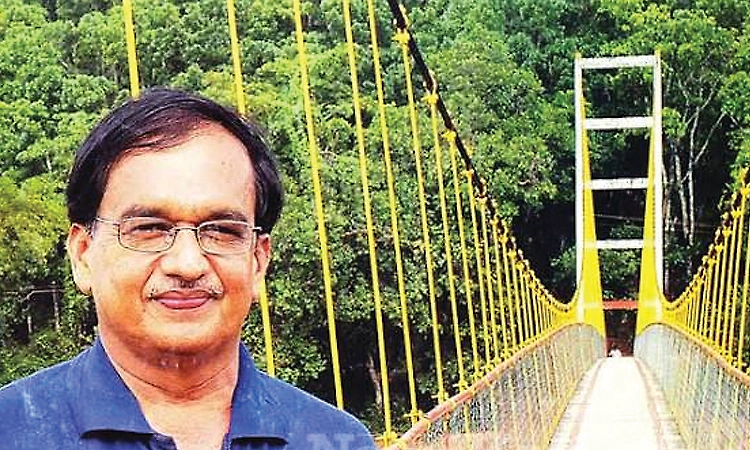
Girish Bharadwaj – bridge builder who connected hearts
Mangaluru
When the monsoon arrived, rivers swelled and villages disappeared from the map. Children stayed away from school. Farmers watched their harvests pile up on one side of the river. Pregnant women and the elderly waited helplessly for boats that often never came. For thousands living in remote corners of the country, a river was not just a waterway-it was a barrier to life itself. For most, it was another monsoon. But for Girish Bharadwaj, it was a challenge that had to be solved.
The Padma Shri awardee from Sullia, fondly known as "Sethu Bandhu" and celebrated as the "Bridgeman of India," passed away on Tuesday, leaving behind a legacy that stretches far beyond steel cables and suspension bridges. He leaves behind stories - stories of kids who completed their education, farmers who found better markets, patients who reached hospitals in time and villages that finally felt connected to the rest of the world. Born on May 2, 1950, in Sullia, Girish Bharadwaj studied mechanical engineering with a simple dream of building a career.
In 1975, he established Ayasshilpa, a steel fabrication workshop in his hometown. It became his workplace, but his real calling lay outside its walls. Every visit to a remote village exposed him to the hardships people endured simply because there was no bridge across a river. He believed engineering should solve problems, not merely create structures. That belief took shape in 1989, when he built his first suspension footbridge across the Payaswini River at Arambur near Sullia.
The bridge was simple in design but extraordinary in its impact. Villagers who once depended on risky boat rides or long detours suddenly had a safe crossing. It was a small beginning, but one that would change the course of his life. That first bridge became the foundation of a movement. Over the next three decades, Girish Bharadwaj designed and built nearly 150 low-cost suspension footbridges across Karnataka, Kerala, Telangana and Odisha. Every bridge carried the same purpose to connect people, not just places.
His innovation was as practical as it was revolutionary. Conventional bridges demanded huge investments and often took years to complete. Bharadwaj showed that a safe suspension bridge could bebuilt in nearly three months and at almost one-tenth the cost. It was an idea rooted in simplicity, backed by engineering expertise and driven by an unwavering commitment to public service. He never worked alone. Villagers became partners in every project, contributing labour, materials and local knowledge. By involving communities, he ensured every bridge be longed to the people who used it.
What emerged was more than infrastructure. It was a shared achievement. The impact was visible almost immediately. School children no longer missed classes during heavy rains. Farmers transported vegetables, spices and arecanut to markets without waiting for rivers to subside. Medical emergencies no longer depended on uncertain weather. Families travelled safely throughout the year and villages once isolated during the monsoon became connected to schools, hospitals, banks and government services.
Many beneficiaries have often said a single bridge changed the direction of their lives. Students pursued higher education because they could attend school regularly. Farmers improved their incomes because transport became easier. Entire communities experienced opportunities that had remained beyond their reach for generations. One of his proudest mile stones came with the completion of his 100th suspension bridge at Mandekolu in Sullia taluk. It was more than another project.
It was proof that meaningful development does not always require massive budgets or complicated systems. Sometimes, it only requires determination, innovation and the courage to think differently. Recognition eventually followed, but it never changed the man he was. In 2017, the Government of India honoured Girish Bharadwaj with the Padma Shri, the nation's fourth-highest civilian award. He also received the Outstanding Young Person of Karnataka Award, the Sir M. Visvesva raya Award, the CNN-IBN 'Be The Change' Award, honours from Rotary International and numerous recognitions from engineering institutions and social organisations.
People affectionately called him the "Vishweshwaraya of Sullia." It was a title born out of admiration rather than ceremony. Like Sir M. Visvesvaraya, Bharadwaj believed engineering was meaningful only when it improved the lives of ordinary people. Despite national recognition, he remained remarkably humble. He preferred visiting bridge sites over attending award functions and found greater satisfaction in watching villagers cross safely than receiving applause.
Every completed bridge was another promise fulfilled, another community connected and another problem solved. As news of his demise spread, tributes poured in from across the country. Engineers remembered his innovation. Social workers praised his commitment. Public leaders hailed his service. But perhaps the most heartfelt tributes came from ordinary villagers who never saw him as an award-winning engineer. To them, he was simply the man who ensured their children reached school safely and their families never again had to fear a flooded river.
Infrastructure is often measured in kilometres, budgets and deadlines. Girish Bharadwaj measured it differently. For him, every bridge represented a child who could dream bigger, a farmer who could earn more, a patient who could receive timely care and a village that no longer felt forgotten. Steel cables may one day be replaced. New bridges will certainly come. But the lives he transformed will remain his greatest achievement.

.jpg)
.jpg)