.jpg)


.jpg)

 English daily published in Bengaluru & Doha

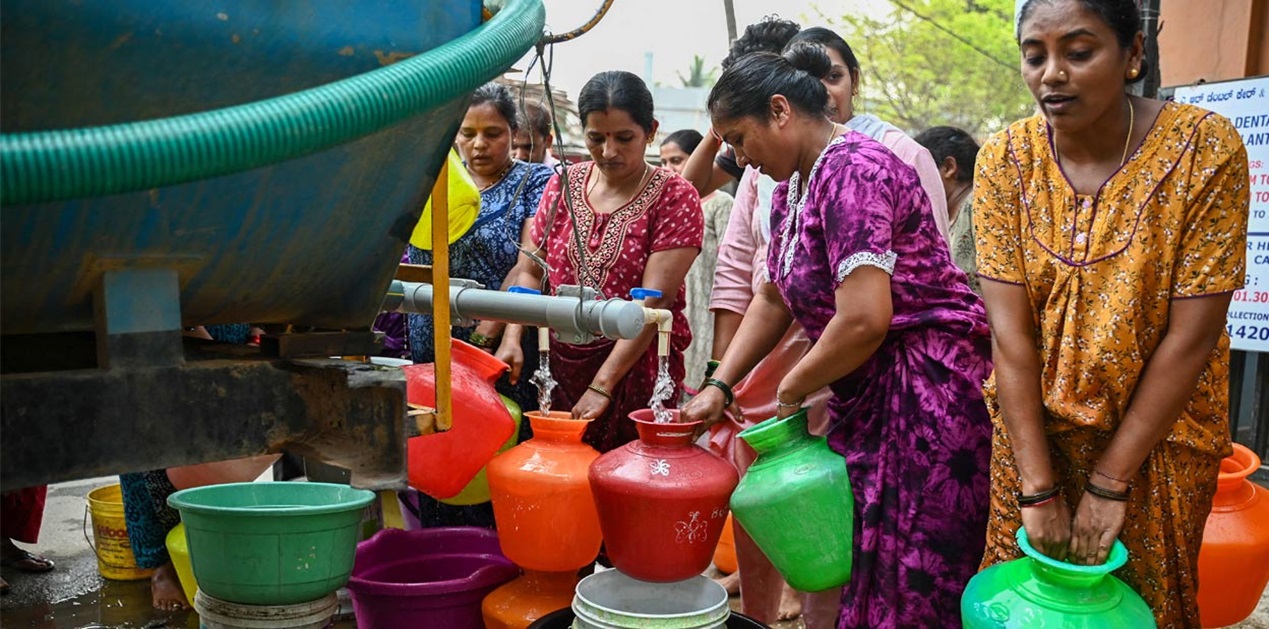
Bengaluru’s drinking water crisis
We are in the same space again: the IT capital does not have enough drinking water. The situation is so bad that the Bangalore Water Supply and Sewerage Board has issued instructions to residents to conserve water and curb wastage. It has banned the use of potable water for gardening, washing vehicles, and similar activities. The board has also made the installation of flow restrictors or aerators in taps mandatory in properties such as commercial establishments, government buildings, and private offices.
The deadline for compliance is July 31. This is exactly what the board did two years ago when the city hit national headlines following an acute water shortage, especially in areas on the out skirts that depend entirely on borewells. As always, the immediate trigger for this crisis is the shortage of rainfall. Between June 1 and July 9 this year, Bengaluru Urban recorded a staggering 35% departure from normal rainfall, which has led to severe groundwater depletion.
This crisis is also self-inflicted. Over the last few decades, several areas have undergone rampant urbanisation, resulting in a massive increase in paved landscapes. One study indicated that between 1973 and 2022, Bengaluru witnessed a staggering 1,078% increase in built-up surfaces. Non-permeable concrete and asphalt now cover more than 93% of the city’s landscape, considerably reducing the percolation of water. Making matters worse is a widening demand-supply gap. There is also the problem of an overstretched and flawed distribution network.
It is estimated that 30% to 40% of the water flowing through pipes is lost due to structural leakages, unrecorded usage, and ageing infrastructure. While public awareness regarding the need to conserve water has undoubtedly increased, measures like rainwater harvesting and wastewater reuse remain highly uneven. For example, high-rise residential complexes treat and reuse wastewater for non potable purposes such as gardening and flushing. However, these solutions are economically viable only in larger communities.
The government must prioritise fixing the potable water crisis before it worsens in the years to come. Solutions like a circular water model should be explored. This involves treating wastewater to a very high standard for safe usage, which will, in turn, reduce dependence on freshwater sources like the Cauvery. Any violation of existing laws, such as mandatory rainwater harvesting systems in residential and commercial complexes, should be strictly addressed with punitive measures.
Alongside government regulations and oversight, it is equally important that every resident of the city takes personal responsibility for saving water. Only by treating water as a finite resource can Bengaluru hope to quench its thirst in an era when climate change has made monsoons unpredictable and erratic.
.jpg)
.jpg)
.jpg)
.jpg)
.jpg)
.jpg)