.jpg)


.jpg)

 English daily published in Bengaluru & Doha

3-nation defence pact: India should be cautious
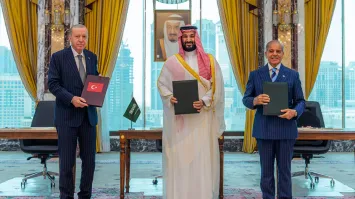
The August 7 Makkah Declaration announcing gov ernments of Turkiye, Pakistan and Saudi Arabia inking a defence pact is all likely to cast long shad ows over the regional security architecture. Apparently, this would be construed as the extension of the pact that Saudi Arabia and Pakistan signed around seven months ago. Coming as it does soon after or amid the US-Iran hostilities in the Gulf, it is natural to believe that it stems from the increasing sense of vulnerability among the oil-rich states due to ineffectiveness of the American security umbrella.
Iranian missile and drone attacks on American bases as well as Israeli defence installations have left the US with a bloodied nose and shattered the myth of Israeli invincibility. Israel, far from being the US neo-colonial outpost in the region, has been forced to seriously reassess and upgrade its multi-layered defence architecture. The pact should be seen as a shift from the con ventional dependence on the United States to finding allies from and within the region.
Saudi Arabia’s financial depth, Turkiye’s military hard ware and Pakistan’s large defence personnel are obviously the elements being seen as the essential compo nents of the triangular alliance and a base with mutually complement ing factors. Curiously, territorial non-contiguity between the three states adds another glue for the three to come together sans frictions. The three being Sunni Muslim nations, there might be compelling reasons to view the pact in the backdrop of Sunni-Shia context.
Iran’s geographic centrality to the region and its absence could be another added reason for reinforcing such doubts. But Iran has scru pulously avoided references to this framework during recent decades. Even during the latest conflict it made it abundantly clear to the Arab neighbours that its attacks would be specifically targeted at American bases and would do no harm to either people or the economic sinews of the nations. No wonder, it was largely successful in rendering the US defence establishment dysfunctional thereby negating the viability of renting a protective umbrella from a distant superpower.
It also might be tempting for security analysts to see it as anti-India realignment what with Pakistan being a key partner in the pact. But Saudi Arabia’s deep and ex panding economic, energy and strategic ties with India provide little scope for this posing a dreadful spectre. However, it does elevate Pakistan’s stature as a secu rity-provider for the Kingdom. There is no gainsaying that New Delhi must be wary of the long-term implications of the pact. As of now, it is worth considering how would the trio interpret the clause “Armed attack against one country is an attack against all countries” if there arises the need for another Operation Sindoor following a terrorist strike from across the border.
.jpg)
.jpg)
.jpg)
.jpg)
.jpg)
.jpg)