.jpg)


.jpg)

 English daily published in Bengaluru & Doha

BJP’s hypocrisy and politics over Vande Mataram
Vande Mataram has triggered controversy for over a century since later stanzas of the song refer to Hindu goddesses, which clashed with the monotheistic Islamic and Christian beliefs. Owing to the concerns raised by a section of Muslim leaders, in 1937, the Indian National Congress, adopted Vande Mataram, but only its first two stanzas as the national song.
Following independence in 1947, free India’s constituent assembly adopted “Jana, Gana, Mana,” composed by Rabindranath Tagore, as India’s national anthem, while Vande Mataram became the national song. But the Bharatiya Janata Party (BJP)-led government at the Centre never leaves a stone unturned to stoke religious discord, disturb communal harmony, and try to reap political dividends through divisive policies.
It made the singing of Vande Mataram mandatory. The saffron party through the Ministry of Home Affairs (MHA) issued comprehensive guidelines formalizing the official protocol for the rendition of Vande Mataram, and specifying when and how it should be played or sung at government and public functions.
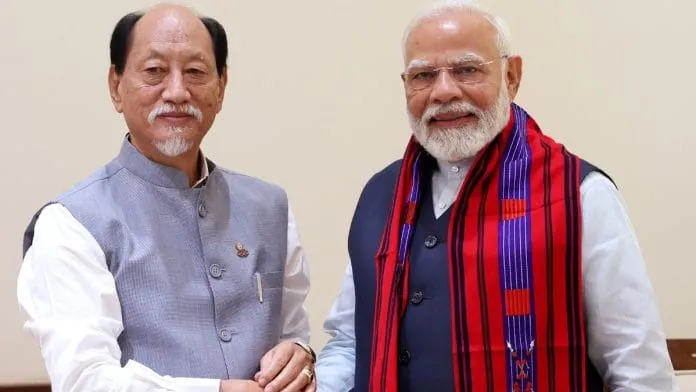
Significantly,strong objections were raised against this diktat from the North-eastern states. The recent 2026 Inde- pendence Day celebrations in these states saw the singing of only the first two stanzas. As a blow to the saffron party, Nagaland’s ruling Naga People’s Front (NPF) opposed the central government’s attempts to compel the singing of Vande Mataram.
Incidentally, the BJP is an alliance partner of the NPF in Nagaland. The NPF has expressed resentment stating that mandatory recitation of the song threatens the religious and cultural identity of Nagaland, and the required performance of the song violates the fundamental rights enshrined in the Constitution.
Legislators and civil society organizations from the Christian-majority states of Meghalaya and Mizoram have also raised objections to the central government’s directive on the national song. The Modi–led BJP government passed the Prevention of Insults to National Honour (Amendment) Bill, 2026, that makes any insult to the national song ‘Vande Mataram’ a punishable offence, in parliament with little debate.
But as far as the furore from Northeast is concerned on Vande Mataram , the saffron party has been mum keeping in mind only political arithmetic because in Meghalaya, Mizoram and Nagaland, it is in alliance to hold on to power. The Nagaland Baptist Church Council and Naga Students’ Federation said that participation involving matters of faith and conscience should remain voluntary. But is the saffron party even listening? Does true national loyalty and respect for national symbols come from voluntary choice, or through state coercion?
.jpg)
.jpg)
.jpg)
.jpg)
.jpg)
.jpg)