.jpg)


.jpg)

 English daily published in Bengaluru & Doha

When public service took the road less travelled
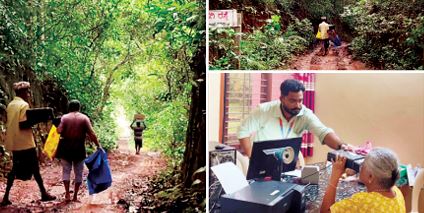
The distance was barely a kilometre, but for the people who walked it, the journey carried a mean ing far greater than the distance itself. Through the hilly terrain of Amma di village in Bantwal taluk, a postal team made its way towards the home of 87-year-old Juliana, carrying the equipment needed to provide an Aadhaar service, turning what could have been a routine administrative requirement into an un usual journey of public service and human con sideration. They were not merely carrying equipment to an elderly woman’s home, they were carrying access to a govern ment service that would otherwise have been difficult for her to reach.
For Juliana, reaching an Aadhaar service centre was difficult because of her age and the terrain surrounding her home. Instead of leaving the elderly woman and her family to find a way around the problem, the service team decided that the easier and more humane solution was to bring the facility to her. The initiative reflects a simple but often over looked principle of public service: when a citizen cannot reach the system, the system must find a way to reach the citizen. The episode came to the attention of the Aadhaar service team through Savitha, a postal delivery worker attached to the Modankapu branch post office.
After learning about Juliana’s difficulty, she brought the matter to the notice of the con cerned officials, ensuring that her situation did not remain unnoticed. Nuthan Bangera, system administrator of the Puttur Division, and his team then arranged the required equipment and set out towards Juliana’s residence, prepared to take the service beyond the walls of the centre and into the difficult terrain surrounding her home. The equipment that normally remains inside a service centre had to be transported along a difficult stretch of terrain.
The team carried the computer and Aadhaar-relat ed equipment for nearly a kilometre before finally reaching the house. Once there, the necessary Aadhaar work was completed, including biometric and mobile number updates, allowing Juliana to access the service without having to undertake the difficult journey herself. Speaking to News Trail, Nuthan Bangera explained the effort involved in reach ing Juliana’s home. “In this case, we came by car as far as possible, but the vehicle could not reach the house.
We then had to walk nearly a kilometre through the hilly terrain, carrying the required equipment, to reach the elderly woman’s home and complete the Aad haar service.” The journey to Ammadi is part of a wider com mitment by the Aadhaar service team under the Puttur Division to make essential services acces sible to people who find it difficult to travel. The team has already taken its services to more than 100 locations, including hospitals and ICUs, where patients unable to visit a service centre have re ceived assistance, while services have also been extended to special children.
Recently, Nuthan and his team provided a similar service to a 96-year old nun at Rosa Mystica, with such initiatives receiving strong support from the Puttur Division. But the Ammadi journey carries a significance of its own because it brings into focus the everyday barriers faced by elderly citizens living in difficult terrain. For an 87-year old woman living amid hilly surroundings, even a short journey to a service centre can become a major undertaking. Distance on a map does not account for age, mobility, transport, difficult roads or the need for someone to accompany an elderly citizen, all of which can turn an ordinary admin istrative requirement into a considerable challenge.
A doorstep service changes that equation by placing the responsibility of reaching the last mile on the service provider rather than the citizen. The episode is particularly relevant at a time when government services are becoming increasingly digital. Technology has made many services faster and more convenient, but convenience is not always the same as accessibility, and there are still people for whom age, distance, mobility and location remain very real barriers. What happened in Ammadi required no grand infrastructure or complicated solution, but it did require awareness, initiative and a willingness to go beyond the conventional boundaries of service delivery.
Savitha noticed the difficulty and brought it to the attention of the offi cials, after which Nuthan and his team responded by gathering the equip ment, taking the vehicle as far as the terrain allowed and then continu ing on foot for nearly a kilometre through the hills. At the end of that dif ficult journey was Juli ana’s home, where an essential government service was brought directly to her doorstep and completed with out requiring the elderly woman to make the jour ney herself. The story is a reminder that public service is not only about offices, counters, applications and technology, but also about recognising when a citizen cannot come to the system and having the willingness to take the system to the citizen. For Juliana, the Aadhaar service may have been a routine adminis trative requirement, but the effort made to deliver it at her home demon strated something much more meaningful: that accessibility should not depend entirely on how easily a citizen can reach an office.

.jpg)
.jpg)