.jpg)


.jpg)

 English daily published in Bengaluru & Doha

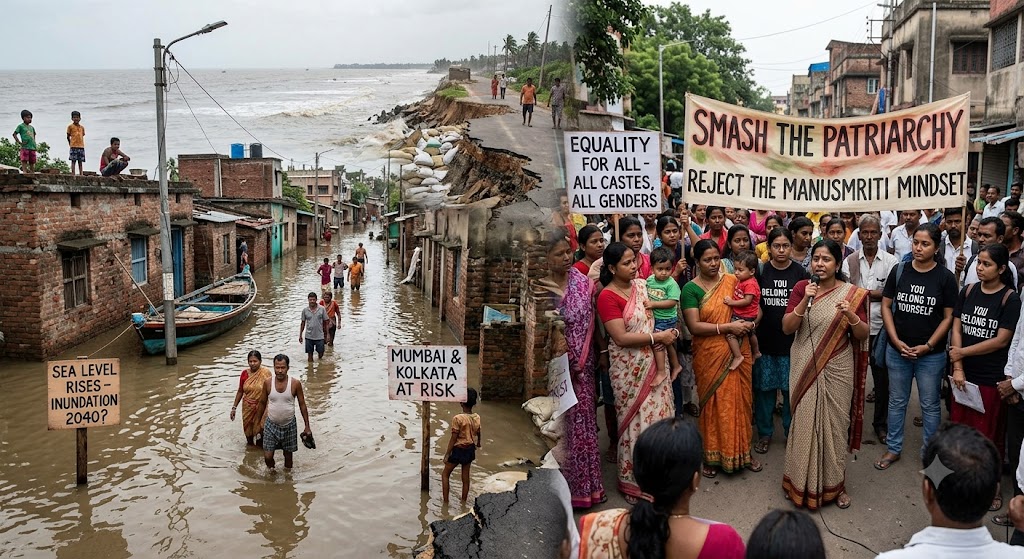
Rising sea levels, millions at risk, but are we ready?
Millions of people in big cities like Kolkata and Mumbai are at immediate risk of losing their homes due to rising sea levels(called SLR) and permanent inundation, a recent report by the United Nations said. But then, it is not only Kolkata or Mumbai; several coastal cities and low-lying areas in India are facing significant threats from rising sea levels, with a chance for permanent inundation and displacement risks, thanks to climate change and El Nino effect. According to NASA and Intergovernmental Panel on Climate Change (IPCC) projections, roughly 12 coastal cities and towns in India are at risk of being submerged by up to 2.7 to 3 feet.
Significantly, with nearly 770 million people, or about 10 percent of the world’s population, living in coastal areas, and less than 5 million living above the high tide line, the risk is acute to say the least. Chennai faces accelerated sea level rise along the Bay of Bengal and increased cyclone intensity, Kochi in Kerala is projected to see substantial water level increases over the coming decades, Visakhapatnam has been identified as vulnerable to coastal flooding and waterfront erosion, while Mangaluru is listed among western coastal cities facing imminent danger from rising waters.
Yes, rising seas are no longer a distant threat, it is hap pening now faster than at any point in recorded history, and the pace is accelerating, making sea level rise one of the most profound threats to populations around the world in developed and developing countries alike. Submergence due to rise in sea levels by 2040 is expected to be more than 10% of the land in Mumbai, Ya nam, and Thoothukudi; 5%–10% in Panaji and Chennai; and 1%–5% in Kochi, Mangaluru, Visakhapatnam, Haldia, Manusmriti is counter to equality. That’s why BJP-RSS is rattled When Rahul Gandhi said ‘smash the patriarchy’ in Pune, he drew a connection between young women’s experience and the text and tradition that justify their subjugation Amitabh Dubey The Manusmriti is back in the discourse after Leader of the Opposition Rahul Gandhi urged women to “smash the patriarchy” and to reject the “Manusmriti mindset” at a 22 August Pune event. A week later, he held a press con- ference to condemn the ‘purification’ ritual held in Haldwani after Congress President Mallikarjun Kharge, who happens to be Dalit, had given a speech.
The BJP-RSS immediately confirmed his point about their Manuvadi mindset. Despite a half-hearted apology from JP Nadda, senior BJP leaders dou bled down in defence of the ceremony. An FIR was filed – not against those who violated the law – but against Gandhi. The only reason this is happening is that Gandhi said the quiet part out loud in his ad dress to young women. He drew a connection between their experience and the text and tradition that justifies their subjugation. Silent counter against democracy The Manusmriti, a 2,000-year old treatise on law and morality, may not be widely read today, but its hierarchical logic structures our society. It is the common sense of WhatsApp uncles and oppressive families.
It stacks humans in a pyramid the moment they’re born, and as signs rules of conduct to each varna, and differential punish ments to each. Shudras, Atishudras and women are born to serve ‘twice-borns ’, i.e. Brahmins, Kshatriyas and Vaishyas, according to the text. It treats Chandalas (Dalits) as outcasts equivalent in status to dogs and other animals, BJP’s instinct to an obviously casteist act against Kharge is to defend the perpetrators. BJP-RSS is, in essence, a force of pushback against constitutional equality. seek to downplay Manusmriti‘s influence or argue that it must be viewed ‘in context’ – but living outside villages, wearing clothes taken from the dead and handling corpses.
A Brahmin may not enslave twice-born individuals but may enslave a Shudra who was created “solely to do slave labour for the Brahmin”. Everybody is disciplined by the rulebook and punished for deviations. It’s no wonder that it has long been the flashpoint of anti caste activism; almost a hundred years ago, it was symbolically burned in the presence of Dr BR Ambedkar, at the second conference of the Mahad Satyagraha. If independent India’s Consti tution and democratic institutions are based on the premise that all Indians have equal political worth, the Manusmriti is the silent counter, carrying the weight of centuries of social power.
In 1949, RSS mouthpiece Organiser proclaimed: “There is nothing Bharatiya about the Indian Constitution”, complaining that it ignored the Manusmriti. The statue of Manu as lawgiver, right outside the Rajasthan High Court, is a reminder that the deep structure endures, no matter what the Constitution promises. Some Right-wing voices now let’s look at the contemporary context. What role does each social group today play, if one looks at boardrooms, univer sities, armies and sanitation work? This is why the prospect of the caste census is so alarming to them and why the Modi government is doing its best to kill it. The numbers would reveal the exact distribution of power in our society.
The so-called protection of women Women are central to this order as the site of reproduction and lineage. Which is why the Manusmriti is a manual on how to cage women, control their ‘fickle, sensual’ nature, and do Manusmriti idea that women need to be safeguarded, rather than questioning a violent male-centred order. all this in the name of protection. Women’s freedom would rat tle the whole social order, and scramble bloodlines and caste purity. This is why Rahul Gandhi’s simple reminder to women – “you belong to yourself” – is a radical statement even in 2026. The Manusmriti binary between ‘good women’ and ‘defiled women’ is visible in conservative responses to violence against them, such as RSS chief Mohan Bhagwat’s response to the 2013 Delhi gangrape.
He said: “Such crimes hardly take place in ‘Bharat’, but they occur frequently in ‘India’”. This implies that women not playing traditional roles or refusing to ‘stay in their lane’ somehow invite sexual violence. Look at the recent Right-wing meltdown over what an ac tress wore in a Rakshabandhan commercial. For the Manusmri ti mentality, a woman cannot simply exist naturally in her own body, wearing what she likes on whatever occasion. She must either be a receptacle of family honour or be slut shamed. “I would like to quote the Manusmriti here, which clearly says that in childhood, a female must be subject to her father, in youth, she belongs to her husband and when her husband is dead, she belongs to her sons. A woman must never be independent,” Rahul Gandhi said in Pune. This is an accurate summary of verses 5.147, 5.148 and 9.3 (see more examples of its attitude toward women here).
The young women who spoke at the Pune event described the violence and fear they face when they step out to study or travel or work on their own. The BJP’s counter to that is protection, which is basically subju gation – a restatement of the Recall what Uttar Pradesh Chief Minister Yogi Adityanath wrote some time ago about women: “Just like urja (energy) left free and unchecked causes destruction, women also don’t need independence; they need protection and proper channelisation. Stree shakti (women’s power) is protected by the father when a child, by the husband when an adult, and by the son in old age. Women cannot be left independent or free.” ‘Indian values’ and ‘sanskaar’ are all too often code for this mindset.
It pervades society and tradition, and it is not difficult to find individuals across the political spectrum who subscribe to its logic. Nor is sexism confined to one community – patriarchy spans all religions. But nobody can deny that the BJP-RSS is the distilled essence of Manusmriti. VD Savarkar described the Manusmriti as “Hindu law” and called it “the basis of our culture-customs, thought and practice.” The second RSS chief MS Golwalkar, praised Manu as “the first and greatest law giver of the world” and declared the varna system valorised in the Manusmriti as “the very core of our concept of ‘nation’.” This is why Prime Minister Na- rendra Modi experienced “cultural shock” on hearing young women using profanity, but his own IT cell is just ‘boys being boys’.
It is why BJP’s instinct to an obviously casteist act against Kharge is to defend the perpetrators. The BJP-RSS is, in essence, the force of push back against constitutional equality. Courtesy: The Print Hyderabad SIR deletions exceed 2023 winning margins in all 15 constituencies, finds report Udupi, Paradip, and Puri.India has an adaptation strategy that could mitigate some of these effects and help prolong its resilience. Toeing in line with India’s effort to mitigate SLR, the 15th Finance Commission earmarked ?1,000 crore for resettling displaced coastal populations and ?1,500 crore for river and coastal erosion mitigation.
While it is encouraging to see that India is not entirely off track regarding the policies and legal measures established to address SLR, it is equally discouraging to acknowledge that the country is not fully aligned due to the diffused nature of its framework and associated initiatives. Unfortunately, the lack of a coherent, integrated policy approach that links river basins, freshwater systems, coasts and the ocean remain insufficiently reflected in regulatory and land use planning frameworks, dispro portionately affecting vulnerable groups and sectors, such as fishing communities, small-scale coastal tourism and port-dependent local economies.
.jpg)
.jpg)
.jpg)
.jpg)
.jpg)
.jpg)